Where the water actually comes from on a Maggie Valley slope
Stand on a typical Maggie Valley lot near the valley floor along Soco Road and the problem is rarely rain landing on your roof. It is rain that landed somewhere uphill of you. The valley's name comes from the bowl it sits in, and the housing follows the grades that drain into it: cabins cut into the hillside on short posts, brick ranches on the flatter benches off Jonathan Creek, and manufactured homes pinned to pads that were dozed level years ago. Every one of them receives water from a neighbor's ground, a county road, or a spring that surfaces partway down the slope and was never piped anywhere in particular.
So the first question a drainage contractor has to answer on a Maggie Valley property is not "what size French drain" but "what is the source." Surface flow off an uphill drive is a grading problem and a swale can often turn it. Groundwater surfacing below the house is a different animal, and no amount of gravel at the foundation wall fixes it. Roof discharge dumped at the corner of a crawl space is the easiest of the three, and the most commonly ignored.
Drive the length of the valley and you can read the drainage history on the ground. On the old farm benches off Hemphill Road and in the flat pockets along Rich Cove, the water table sits high in spring and the yards stay soft long after a rain stops. Higher up the coves, past the point where the pavement ends, the source is more often a seep that shows up at the same elevation on three or four properties in a row, which is the giveaway that it is a perched water table and not a broken pipe. Neither one is solved the same way, and a crew that does not walk the slope before quoting is guessing.
What the fix looks like, and what it costs here
Slope lots in Haywood County change the shape of a drainage job in two ways: the outlet has to go somewhere legal and downhill, and the trench often has to cut through rock or heavy clay that dozed fill left behind. Both add labor that a flat-lot quote never accounts for. The table below reflects residential scopes as they actually price in this terrain; the county-wide detail sits in the Haywood County grading cost breakdown.
| Scope | Typical residential range | What moves the number |
|---|---|---|
| Single French drain run | $3,000–$9,000 | Run length, trench depth, rock, outlet distance |
| Catch basin + buried downspout system | $3,500–$8,000 | Number of inlets, pipe diameter, tie-in to daylight |
| Surface swale and channel work | $3,500–$7,500 | Linear feet, grade drop available, riprap or turf finish |
| Curtain drain for uphill groundwater | $5,500–$12,000 | Depth to the water table, spoils haul-off, rock |
| Whole-yard regrading to re-establish fall | $15,000 and up | Yard size, slope, retaining needs, revegetation |
Two line items surprise people. First, the outlet: if the only legal discharge point is a long run downhill or into an approved storm system, that pipe is a real cost, and it is where a cheap bid usually goes missing. Second, spoils. A trench through clay produces dirt that has to go somewhere, and on a tight mountain lot "somewhere" is often a dump fee.
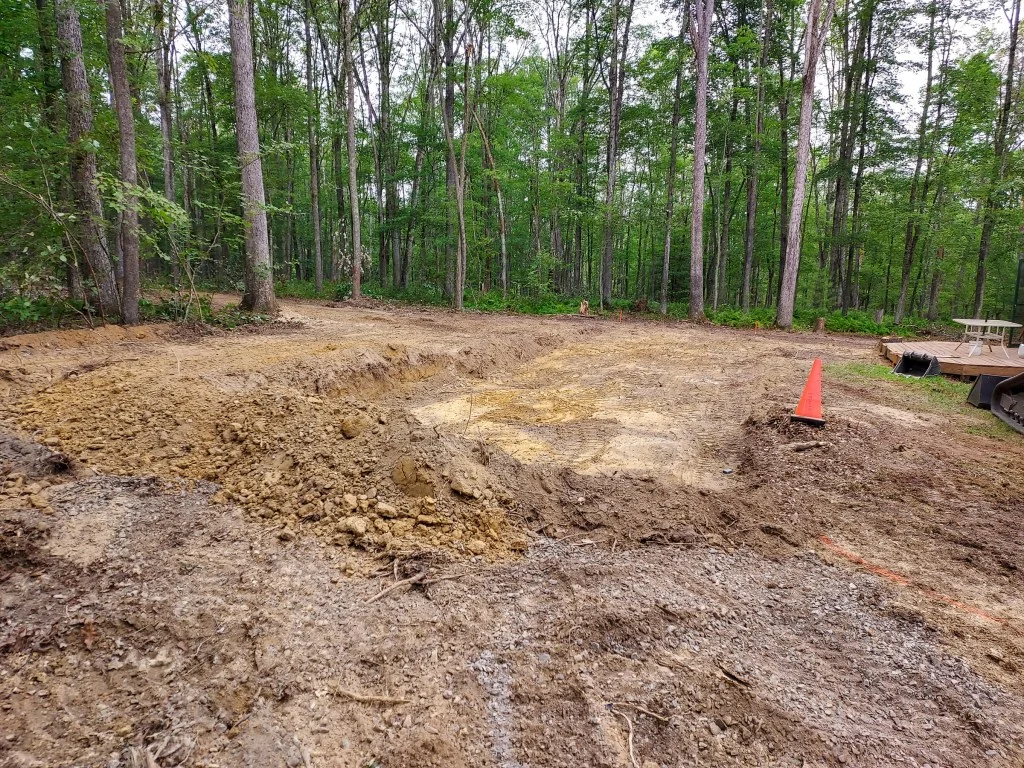
A single run along the uphill side of a house might be a day and a half of work when the ground is forgiving. Put that same run behind a cabin off Fie Top Road, where the trench hits weathered rock and the spoils have to be carried out by hand because the track cannot get around the corner, and it becomes three days. That gap is the whole story of why a Maggie Valley drainage number does not travel from one lot to the next. A swale on a shallow gradient with a legal daylights, on the other hand, can be one of the least expensive fixes on the list — provided there is enough fall to make water move, which on some of these benches there is not.
The rules that shape a drainage job in Haywood County
Moving dirt and water on a slope is regulated work, and the thresholds are real. The North Carolina Licensing Board for General Contractors sets the point at which a project needs a licensed general contractor, and drainage and grading scopes cross it more often than homeowners expect. Separately, any work that touches a septic system's drain field or its repair area is not a drainage job at all — that is licensed plumbing and septic territory under the NC State Board of Examiners of Plumbing, Heating and Fire Sprinkler Contractors, and rerouting surface water across a drain field is a common and expensive mistake.
Add the storm record. 19 federally declared events touch this county across 1973-2026, and the pattern is overwhelmingly flood and storm family. That history is why the county's erosion and sediment expectations are not paperwork theater: a trench left open on a mountainside during a summer downpour will move soil, and moved soil off a Maggie Valley slope ends up somewhere the county has to deal with. The drainage and erosion control guide walks through what a compliant plan looks like before a shovel touches ground.
There is a practical side to this that locals learn the hard way. When a summer storm parks over the Plott Balsams and dumps inches in an hour, water does not respect the property line a surveyor drew. It follows the old contours, the logging roads, and the fill edges. A plan that only accounts for the current lot and not the water arriving from above it is the plan that fails in the first big event. That is also why the county cares about sediment: one open trench can push dirt into a roadside ditch and from there into Jonathan Creek, and cleanup after the fact costs more than doing it right once.
Reading a bid on mountain terrain
A complete bid on a slope lot answers four things: where the water enters the property, where the pipe or swale discharges, how the trench is backfilled and revegetated, and who handles spoils. If a proposal names a pipe size and a price but not an outlet, it is half a plan. Ask for the outlet on every line item and see whether the number holds.
Ask, too, whether the crew has worked ground like yours — a curtain drain through old fill off a dozed pad behaves differently than a run in flat clay, and the crews that do this work in the valley know where the rock sits. When you are ready to compare scopes, the Maggie Valley grading contractor page covers how to vet crews for this specific terrain, and any full-yard regrade should be sequenced against the erosion plan rather than around it.
Two questions worth asking out loud. Where does the water go when the ground is already saturated — not on a dry day, but after three days of rain? And can the outlet be inspected? A buried outlet that cannot be found later is a liability, and on these lots it is often the first thing to clog with leaves and gravel. A bid that leaves a clean, visible, riprapped outlet you can check after every storm is worth more than the same bid with a lower number and a mystery pipe under the yard. Ask also how the crew plans to handle the transition where the drain meets the driveway apron, because that is where surface flow and pipe flow fight, and it is where most callbacks on mountain properties begin.