Before you dig: read the water your driveway already carries
Most culvert money in Black Mountain gets spent twice, because the first pipe was sized to the driveway instead of the water. This town sits in the Swannanoa Valley at the foot of the Black Mountains, and the ground here sheds hard: a gravel drive off a ridge road can carry more storm flow than a flatland culvert twice its length was ever built for. Before anyone quotes a pipe, walk the uphill side of the drive on a rainy day. Where does the water cross now? Where does it pool? Where did it cut a channel last spring?
If your drive has been there a while, the existing culvert is a free engineering report. Pull the inlet headwall and look: a pipe running half full with a scour line near the top means the barrel is undersized for the ditch it serves. A pipe running full and backing up into the road means the same thing louder. And a pipe that is crushed, rusted through, or bowed in the middle is not a maintenance problem, it is a replacement, and no amount of regrading the driveway will fix a collapsed barrel.
That is the honest sequence. Water first, then the pipe, then the gravel. Anyone who quotes a driveway rebuild before they have seen your inlet is guessing with your money.
What a Black Mountain culvert scope actually includes
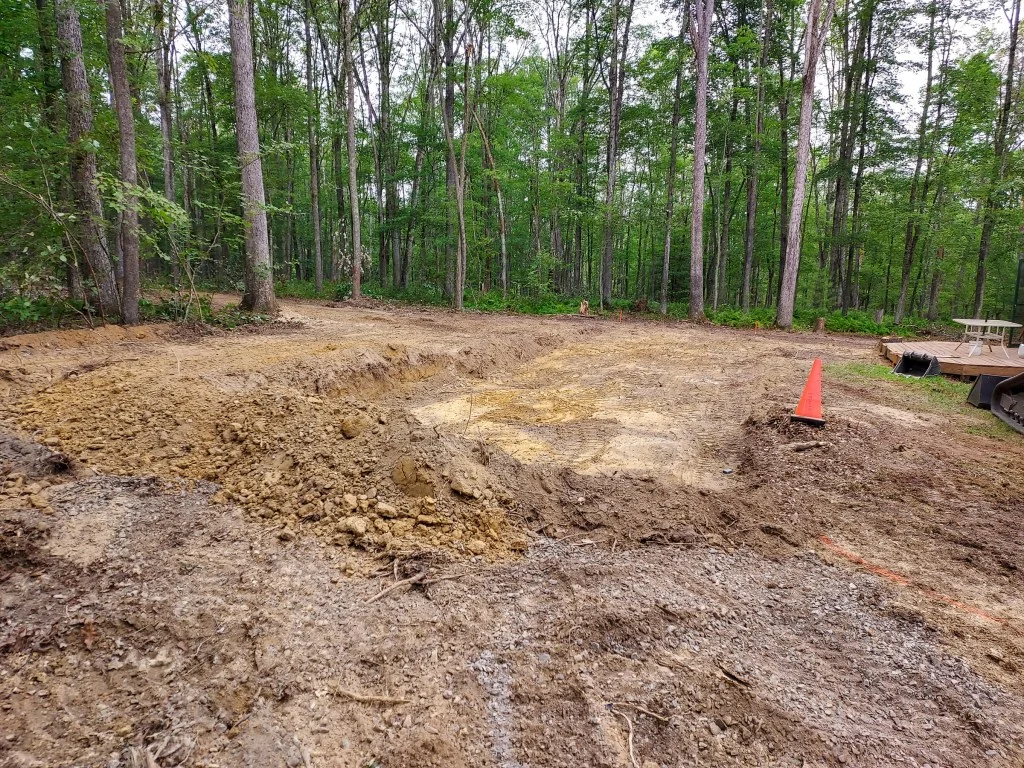
A complete job on a typical valley-lot driveway here is more than a stick of pipe in a ditch. The working scope usually runs: locate and daylight the ditch on both sides, excavate the crossing to the right depth and fall, set bedding stone, lay pipe with correct slope (a minimum of about 1 percent fall on the pipe for positive drainage), build or reset a headwall at the inlet, armor the outlet with riprap so it does not cut a hole in the downhill slope, and restore the driveway surface with compacted crushed stone.
Two Black Mountain specifics change that scope more than anything else. First, grade: a lot with 20 feet of fall from the road to the house gives you more pipe fall opportunity than a flat lot but also puts real energy in the outlet water, which is why outlet protection matters here and is easy to skip on a low bid. Second, springs: this valley has more than its share of wet-weather and year-round springs, and a spring crossing the drive is a different problem from storm runoff. If the flow never stops in August, you are sizing for base flow plus storm, which pushes toward the top of the standard range.
Pipe material and size: what drives the number
Sizing is done off watershed acres draining to the culvert, not off driveway width. A rule of thumb many crews use for steep mountain ground is a 15-inch minimum for a standard residential drive, stepping to 18 or 24 inches as the contributing drainage grows. Undersizing is the single most common culvert mistake in this county, and it shows up as a washed-out driveway two springs later.
Material choice matters less to performance than people think, but it matters to price and lifespan. Corrugated high-density polyethylene is the common residential choice, light, flexible, and easy to set. Corrugated metal can be cheaper up front in some sizes but rusts out faster in our wet ground and is a poor bet under a paved drive where replacement means cutting asphalt. Reinforced concrete pipe costs the most and lasts the longest, which is why long runs and public or commercial crossings lean that way.
Whatever the material, a culvert on a live creek or a designated waterway is a different permitting situation than a roadside ditch crossing, and getting that wrong is expensive. The EPA maintains the federal wetland and waterway framework that state and county rules build on, and any pipe placed in a mapped stream should be checked against it before excavation.
| Scope | Typical installed range |
|---|---|
| Short residential drive crossing, 15–18 inch pipe | $1,500 – $2,500 |
| Standard driveway culvert with headwall and outlet protection | $2,500 – $4,500 |
| Long run or high-flow crossing, larger pipe | $6,000 – $9,500 |
| Concrete pipe where asphalt or heavy loads are involved | $6,000 – $9,500 |
| Spring-fed or creek-adjacent crossing | Top of the range, quoted after site review |
For a fuller picture of how grading work prices around the county, see the Buncombe County grading cost breakdown.
When the smart money is not installing a culvert at all
Sometimes the right answer is to rework the grade instead of burying a pipe. If your driveway is shedding water because the ditch is shallow and the grade is wrong, regrading the ditch and crowning the drive may be the whole fix. If a culvert is being asked to carry water that a relocated ditch could shed off the drive entirely, you are buying pipe to solve a drainage problem. We would rather tell you that on the first visit than sell you a barrel you do not need.
On the other hand, if the existing pipe is under the drive and buried, replacement is the job, and the driveway comes up. Get the pipe spec, the fall, and the outlet protection in writing before that starts, because re-doing it means tearing out the same gravel twice.
If you are also looking at larger site work, our culvert and driveway pipe guide walks through the install from ditch to outlet, and the Black Mountain grading contractor page covers the earthwork side. Hiring properly matters here as everywhere: North Carolina draws a licensing line at project value, and the NC Licensing Board for General Contractors has the thresholds. The International Code Council publishes the model codes that most local storm drainage rules are adapted from.
Weather, water, and why this valley keeps the phone ringing
Buncombe County has been touched by 19 federal disaster declarations stretching over 1973-2026, and the overwhelming majority of those events were storm and flood family. That is not trivia, it is the reason culvert calls spike here after heavy rain. The National Weather Service issues the flood watches that should be your cue to walk your ditch and inlet. Every one of those events pushed water through driveways that were built for a drier assumption, and each one moved another round of gravel into somebody's yard.
If your culvert washed out once, it will wash out again, and next time it may not be the gravel that goes. The fix is usually one size up in pipe plus real outlet protection, not the same pipe set back in the same hole.