Where a Weaverville pad budget actually goes
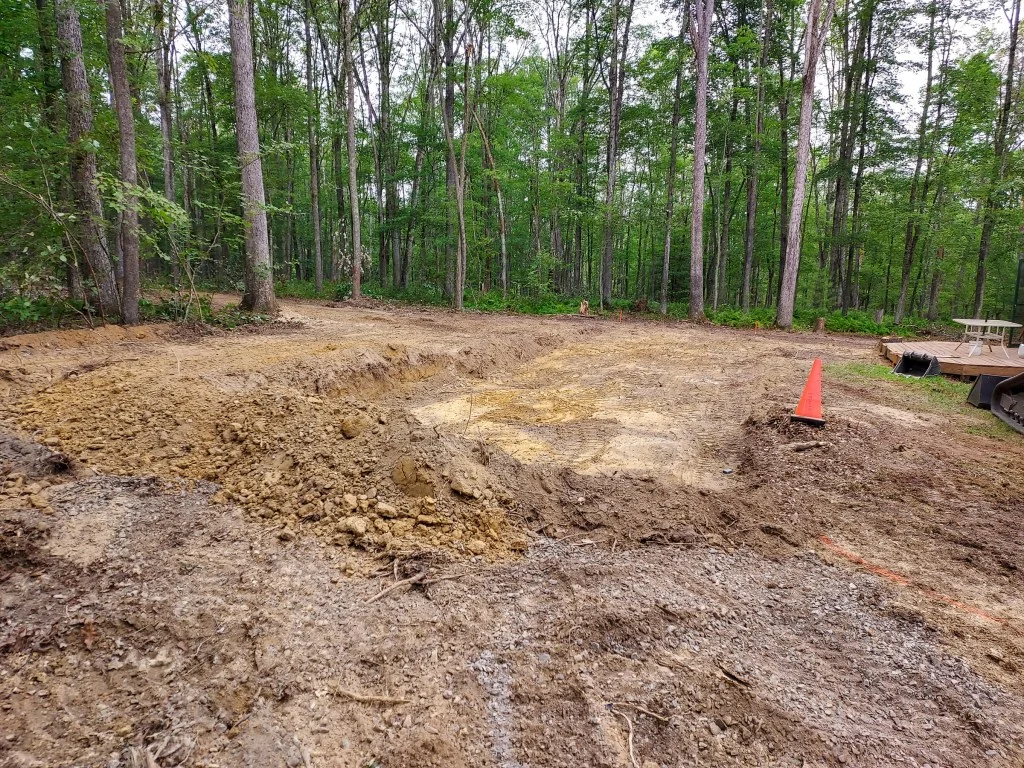
Most quotes that shock people in Weaverville are not overpriced — they are just showing line items the homeowner never pictured. A pad is not one price. It is five numbers stacked: clearing and grubbing, cut and fill, compaction in lifts, drainage and erosion control, and the gravel base itself. On flat ground near the valley floor, those five collapse into a tidy mid-band number. On a Reems Creek hollow or a wooded ridge lot off Ox Creek Road, the same five items can each double.
The pattern worth knowing: this town straddles two ground types. Valley-floor lots off Weaverville Highway push topsoil and shallow grades — cheap, fast, low risk. Hillside lots above the valley force real cut, retaining, and haul-off — expensive, slow, engineering-dependent. Two neighbors a mile apart can get quotes that differ by a factor of three and both be honest.
The line items, in plain numbers
Every price on a Weaverville pad traces back to one of these. Use the table as a scope check against the Buncombe County grading cost breakdown, then read the line items your bidder did or did not include.
| Scope item | Typical range | What drives it |
|---|---|---|
| Clearing & grubbing | $1,200–$4,500 | Tree size and count, stump removal, haul-off distance |
| Cut & fill earthwork | $2,000–$9,000 | Slope, volume moved, soil type (clay vs. rock), how far dirt travels |
| Compaction in lifts | $600–$2,200 | Depth of fill, testing requirement, moisture conditioning |
| Drainage & erosion control | $800–$3,500 | Swales, culverts, silt fence, downspout routing, post-construction water |
| Gravel base built-up | $1,400–$5,000 | Square footage, stone type and thickness, delivery cost |
| Retaining / shoring (if needed) | $2,000–$12,000 | Wall height, engineering, slope above or below pad |
A $4,000 quote and a $14,000 quote on the same lot usually differ because one of these rows is missing. Ask every bidder to write each line item, or state plainly it is not needed and why. The site prep and building pads guide walks through what each phase should include.
Weaverville's wet season reshapes a pad budget
Buncombe County's federal disaster record is a working document here: 19 declared events touch this county across 1973-2026, overwhelmingly storm and flood family. That history is why erosion control and post-construction drainage are not optional line items in Weaverville — they are the difference between a pad that survives its first spring and one that washes at the edges. The National Weather Service tracks the pattern: heavy, sustained rain events that find any grade mistake a builder left. The budget response is simple. Fund the drainage row before you fund the gravel row. A pad without water routing is a pad with a countdown.
Permits, licensing, and the checks that matter
Land disturbance in North Carolina comes with real rules once you cross the state threshold for disturbed acreage, and grading is not a handshake trade. The NC Licensing Board for General Contractors sets when a job requires a licensed general contractor, and pad work plus a house build almost always crosses it. Ask for the license, ask for proof of the erosion-control plan if one is required, and ask who inspects the compaction before concrete or footings go down. For pads serving a home with plumbing rough-in, the NC State Board of Examiners of Plumbing, Heating and Fire Sprinkler Contractors governs that separate scope. And if the pad is for a manufactured or modular home, HUD standards apply to the foundation system underneath.
Two more local questions filter crews fast. First: what soil did you find on the last pad within five miles of here — clay, rock, or fill? Second: how do you compact, and do you test? A crew that answers both with specifics is a crew that has done this exact ground. A crew that answers vaguely is a crew that will hand you change orders. When you start calling around, the Weaverville grading contractors list is the place to begin the shortlist.
Reading a bid without buying trouble
A good Weaverville bid is boring. It names the cubic yards moved, the depth of fill, whether the gravel is #57 or crush-and-run, where the downspouts go, and what happens to the stumps and spoils. A thin bid is short and cheap and will grow once the machine is on site. The honest test is not the bottom line — it is whether the scope matches the lot. On a valley-floor lot, a clean mid-band bid is likely complete. On a hillside lot, the low bid is almost always the one missing retaining, haul-off, or compaction testing, and you will pay for those later at a worse price.
Also confirm sequencing. Pads built in the county's wet months hold moisture differently than summer pads, and a compaction schedule written for July ground can fail in a February install. The best crews schedule around it and say so in writing. That detail is the difference between a pad that has moved a quarter inch in ten years and one that has to be re-cut before the framers arrive.