Read what's already cut before you cut again
Etowah sits south of Hendersonville in the French Broad valley, where a lot of property was cut and filled decades ago, built out, and then left to settle. That history is why we usually walk a site and ask about the old grade first. Nine times out of ten, the failing driveway or ponding pad in front of a house was never the subgrade. It was a culvert that silted shut, a swale that got filled in during a landscaping project, or a cut that dumped the whole hillside's runoff onto one corner of the slab. Re-grading a pad that sheds water the wrong direction just moves the problem downhill.
We look for the same four things on every Etowah site: where the high side is, where water currently exits, whether the fill under the pad was compacted or just pushed, and whether the driveway crown still has anywhere to drain. If the answer to those is workable, a fix-up is almost always cheaper than a redo, and we'll say so.
What makes Etowah different from the rest of Henderson County is the age of the cut. A lot of these pads went in when Etowah was still orchard and pasture country, before the push of the 1990s and 2000s filled in the valley. That means the fill you're standing on may be thirty or forty years old, and it has either consolidated or it hasn't. We probe it. A probe rod pushed into a suspect corner tells you more in ten minutes than a whole afternoon of guessing. If it goes in easy, the fill is loose or wet, and no amount of re-crowning will save it. If it resists, the subgrade is probably fine and the problem is surface water.
We also look at the driveway apron where it meets the road. In Etowah, that apron is often the actual failure point. The county road crown sheds water toward the shoulder, the shoulder has grown up over the years, and now the driveway is the low spot. Water runs off the road, into the drive, down to the pad, and sits. That's not a pad problem. That's a ditch and culvert problem, and it's a fraction of the cost to fix.
What a building pad actually involves here
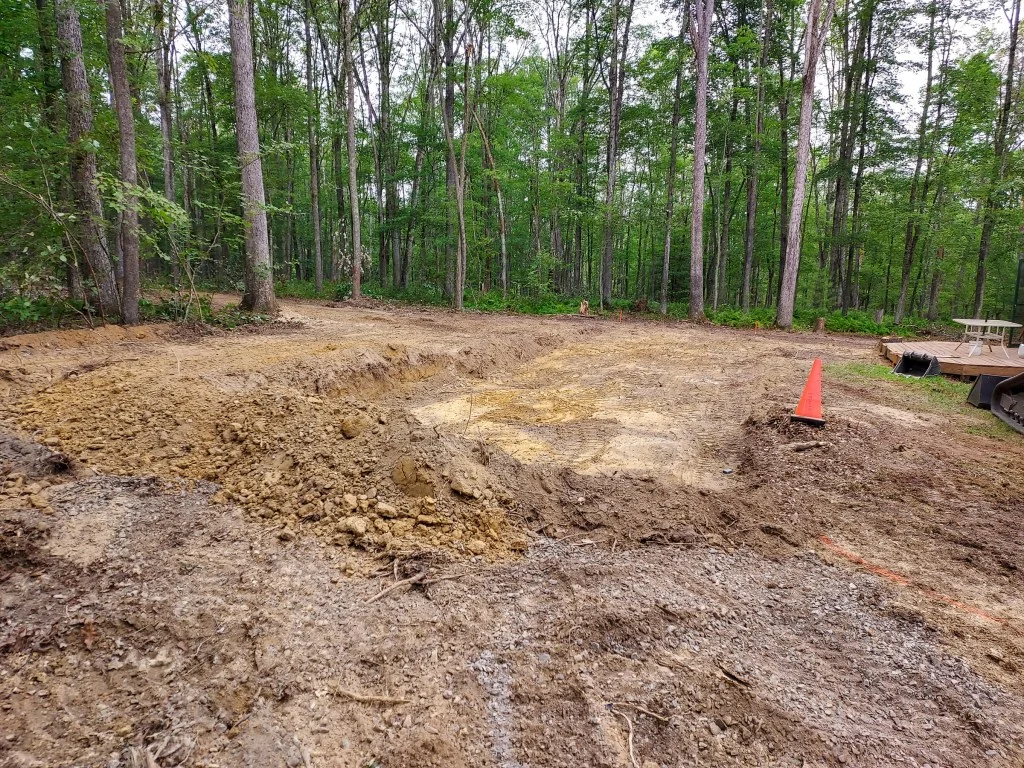
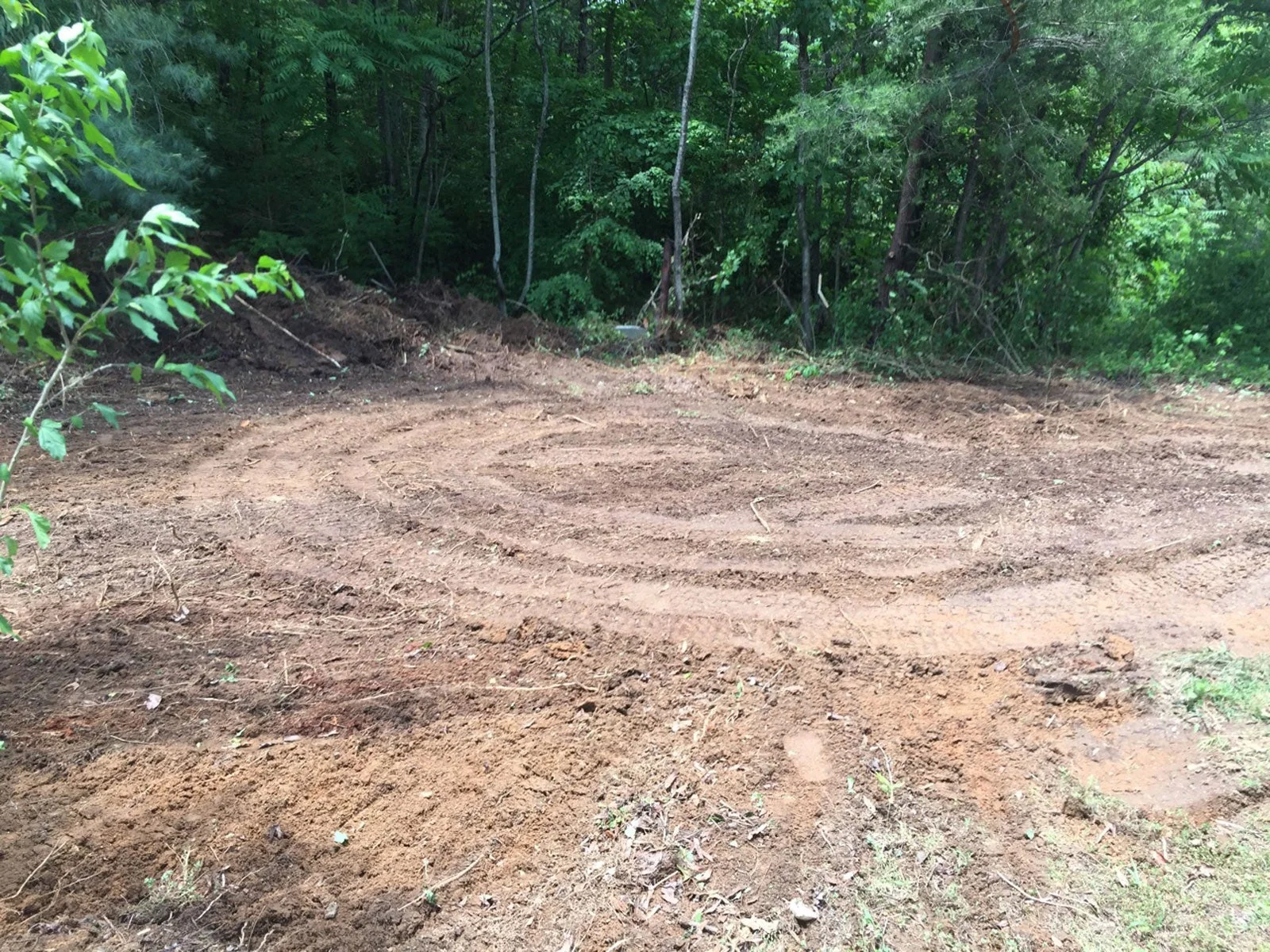
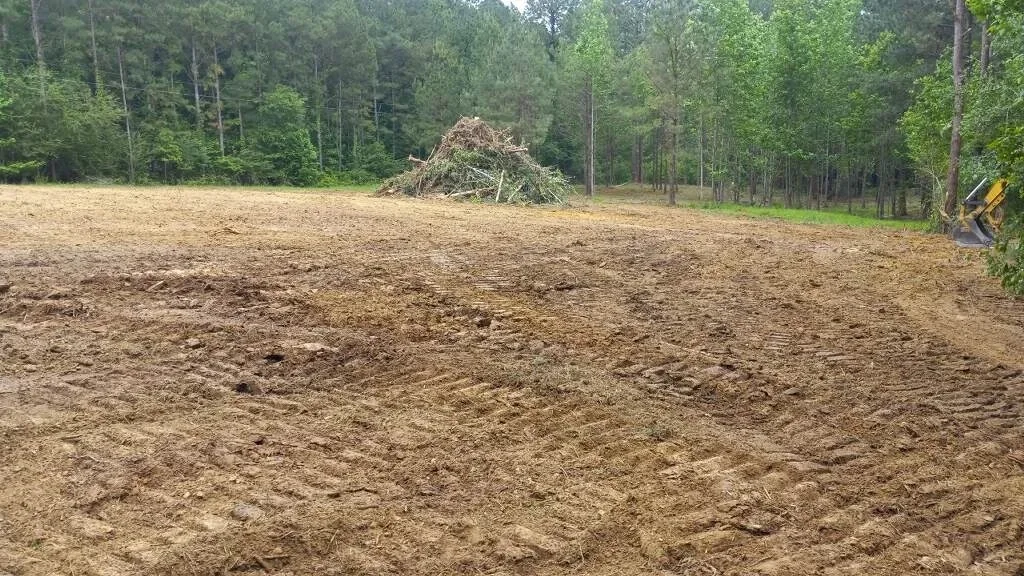
Site prep in Etowah is less about the flat part and more about the edges. Henderson County ground runs from creek-bottom clay to red clay with rock close to grade, and the French Broad floodplain along the river corridor behaves differently from the slopes above it. A pad is four moves: clear and grub, strip the organics, cut and fill to a design elevation, then compact in lifts at a moisture content the material will actually hold. The last part is where cheap work shows up later as a cracked slab or a settled garage corner.
Lots along the river corridor also carry floodplain considerations that change how high the pad must sit and how it drains. Those are genuine code questions, and the NC Licensing Board for General Contractors sets the threshold for when a job that broad enough needs a licensed general contractor instead of a handshake. Grading alone can often stay with a grading contractor; grading plus a structure or a full site package usually crosses that line. Worth knowing before you sign.
Etowah-specific detail that matters: the terrain here is not one thing. You can be on a flat bench above the river bottoms and then, a quarter mile up the road, on a side slope that drops hard toward a creek. The soil changes too. Creek-bottom ground near the French Broad and its tributaries tends to hold moisture and turn greasy after a rain. The red clay uplands drain faster and compact harder but can be slick when wet and brick-like when dry. Neither is bad. Both require the crew to adjust moisture and lift thickness on the fly, which is why a machine operator who has worked this valley is worth more here than a bigger excavator.
Rock is the other reality. In the upland pockets, especially as you climb away from the river, you hit weathered rock and sometimes ledge close to grade. That changes cut cost fast, and it changes how you handle the pad edges. Where you can't cut, you fill and retain, and that retaining question is where a lot of budgets move. We'd rather find that with a probe and a walk than with a machine on the clock.
Etowah pad and prep cost picture
Etowah prices track Henderson County generally, with a local bump for river-corridor lots and mountain-facing slopes. The full line-item breakdown lives in the Henderson County grading cost table. The working ranges below are what we actually see quoted:
| Scope | Typical range | What moves it |
|---|---|---|
| Re-grade / re-crown an existing pad | $3,500 – $6,500 | Whether culverts and swales are salvageable |
| New pad, gentle lot, some clearing | $6,000 – $12,000 | Tree count, haul-off distance, fill volume |
| New pad, wooded or cross-sloped lot | $12,000 – $22,000 | Cut volume, retaining, erosion control |
| Steep, rocky, or river-corridor lot | $22,000 – $30,000 | Rock, engineered fill, floodplain elevation |
A number much under the low row is either a very small touch-up or a bid that skipped compaction and drainage. Ask which.
The re-grade row is the one most Etowah homeowners should be looking at first. If your existing pad is ponding, if the driveway is washing out at the bottom, if the garage floor is damp along one wall, those are the symptoms of a drainage fix, not a rebuild. We've re-crowned pads in the Etowah valley for a fraction of what the homeowner was quoted for a tear-out, simply because we started by reading the water instead of by firing up the machine.
Where the cost genuinely climbs is haul-off and fill. If your lot is in a tight spot off one of the back roads and the cut spoils have to leave the site, trucking adds up quickly. If the lot has good on-site material and a place to waste it, that number drops. Same with trees. A cleared lot is one thing; a lot that still has mature hardwoods over the build envelope is another, because clearing, stump removal, and haul-off are all real line items, and in Henderson County those stumps don't burn on site.
One more honest note: the quotes that come in lowest are usually the ones that leave drainage off the page. Ask any bidder to show you, on paper, where water exits the pad after they finish. If they can't point to a swale, a culvert, or a designed outfall, they're not done with the scope.
Water, permits, and the part most bids miss
Henderson County's storm record is the same story as the rest of the mountains: 16 declared federal events touch this county across 1978-2026, and the overwhelming majority are storm and flood family. If your pad or driveway has been overtopped even once, that's your design case, not a freak year. Erosion control plans, silt fence, and a stabilized construction entrance aren't paperwork theater on a slope, and the EPA stormwater guidance is the plain-language version of why disturbed ground has to be held in place before it rains.
Practical sequence we use on Etowah jobs: read the existing drainage, decide fix-versus-redo, pull any required permits, rough grade, install erosion control, then finish grade and compact. Skipping to finish grade is the most common expensive mistake we see. If a job includes any plumbing stub or fire-sprinkler work, the NC State Board of Examiners of Plumbing, Heating and Fire Sprinkler Contractors is the licensing body to check.
The water story in Etowah is really a high-side story. Most of this valley drains toward the French Broad, which means most lots have an uphill direction, and whatever happens uphill comes through. The neighbor's driveway, the county road ditch, a spring that shows up after a wet winter, all of it arrives at your pad if nobody planned for it. We've seen pads that were fine for fifteen years and then started ponding after a new house went in above them. The fix isn't to regrade the lower pad. It's to intercept the water above it and give it a path around. That's a much smaller job, and it belongs in your scope from the start, not as an afterthought once the slab is poured.
Erosion control on Etowah slopes also has to be maintained, not just installed. Silt fence fills up in one hard rain if the slope above it is disturbed and unprotected. Part of a good scope is a plan for who comes back after the first storm to clean it out. Ask that question before you hire. The answer tells you whether the crew has done this in the mountains or only on flat ground.
Choosing a crew in this valley
Two Etowah-specific questions separate the good crews from the drive-by ones. First: will you read the existing grade before quoting? If the answer is no, they're selling earthmoving, not site prep. Second: how do you handle the high side? The uphill neighbor's runoff is the single most common cause of a re-do here, and anyone who won't talk about it plainly is planning to leave that problem for you. Our site prep and building pads guide walks through what a proper scope includes, and grading contractors in Etowah covers the local trade.
A third question, subtler: do they know the difference between Etowah's river-bottom ground and its upland clay? If a crew talks about moisture and compaction the same way on both, they haven't worked enough of this county. The bottom ground needs more drying time and careful lift thickness. The upland clay needs water added in dry spells. Same trade, different judgment call, and the judgment is what you're actually paying for.
Timing matters here too. Etowah sees wet winters and wet springs, and a lot of grading work that's miserable in February is straightforward in late summer. A crew that will tell you when to do the work, not just what the work costs, is a crew that's thinking about your finished pad and not just the invoice. If a bidder is pushing you to start in the wettest month of the year on a bottom-ground lot, ask why. The honest answer is usually that they need the work, not that your site is ready.
Finally, get the fix-or-redo read in writing. Even a one-paragraph scope that says what's being repaired versus what's being rebuilt keeps everybody honest. That's the whole point of reading the existing grade first, and it's the habit that saves Etowah homeowners the most money on site prep.