The existing driveway usually decides your number
Drive the Edneyville and Fruitland ridgelines and you'll see the same pattern on lot after lot: a cut-in driveway that was built for one house, a graded house pad sitting above it, and a culvert somewhere below doing more work than anyone remembers. When a landowner calls for a clearing quote, the first useful question isn't how many acres. It's whether the existing access and drainage are worth keeping. A driveway that already sheds water, holds gravel through a Henderson County clay winter, and reaches the buildable bench saves you thousands you'd otherwise spend re-cutting, re-grading, and re-stoning. A driveway that funnels runoff onto the pad is going to cost you the clearing plus the redo. Read what's there before you pay to remove it. That one walk-through reshapes the whole budget, and it's the reason our land clearing cost guide starts with site inventory rather than acreage.
The same logic runs through every older parcel in the county. Lots subdivided off a family farm in the 1970s and 1980s often inherited a gravel pull-off that was never engineered for regular traffic, let alone a loaded dump truck or a track hoe. If that pull-off climbs a 15 to 20 percent pitch to reach a bench, the crew has to decide whether to improve it in place or cut a fresh one. Improving in place is almost always cheaper, but only if the subgrade is holding. After a wet February, some of these driveways pump and rut under their own gravel, and no amount of stone fixes a base that never drained. A bidder who walks that lane with you and points out where the water is actually going is worth more than one who quotes off a satellite image.
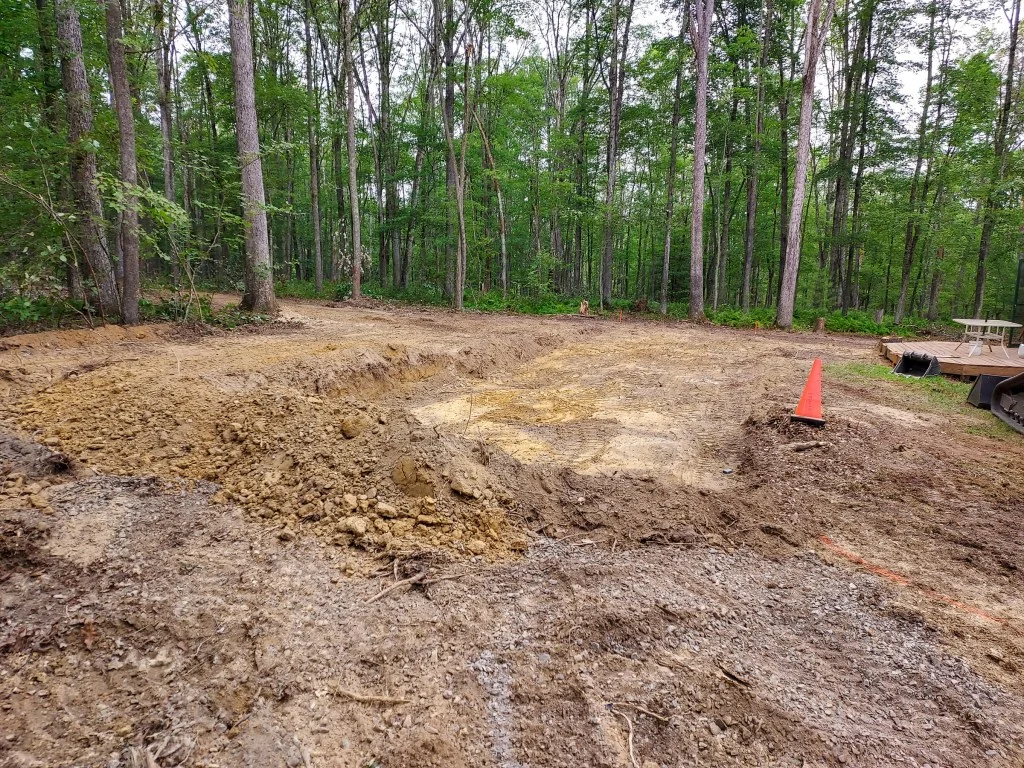
The buildable bench matters just as much as the access. On many Henderson County tracts, the previous owner cleared a homesite pad years ago and never built. That pad may be perfectly usable, or it may be sitting on fill that was never compacted and now holds a soft spot. Just because a rectangle of grass is flat does not mean it is ready for a foundation. When the machines are already on site for clearing, re-working that pad is a bargain compared to doing it as a separate mobilization months later. That is why clearing and grading belong in one conversation on this terrain, and why we treat the existing pad as an asset to inspect, not a blank slate to ignore.
What Henderson County landowners actually pay
Henderson County is not one terrain. Flat pasture off Howard Gap Road prices nothing like a laurel-thick slope above Saluda, and a chestnut-oak stump on a 30 percent grade is a different animal than a cedar sapling in a fence line. The county runs from the relatively gentle bottomland near the French Broad and Mud Creek up into the steep hardwood coves that drain toward the Green River watershed and the edge of the Blue Ridge escarpment. A lot's price tracks that geography far more than its acreage number. So treat the table below as working ranges, not quotes. A firm number before the crew sees stump diameter, rock, and where the dirt goes is a guess. Land clearing contractors typically factor in machine hours, disposal, and the cost of moving — and re-moving — the same dirt.
| Scope of work | Typical Henderson range | What drives it |
|---|---|---|
| Light clearing / brush and undergrowth | $1,200 – $2,400 per acre | stem size, density, disposal method |
| Moderate clearing / mixed hardwoods | $2,400 – $4,500 per acre | tree diameter, stump grinding, haul-off |
| Heavy clearing / steep, densely wooded | $5,000 – $8,500+ per acre | grade, access, rock, dirt relocation |
| Stump removal (per stump, after clearing) | $150 – $600+ | diameter, grind vs. pull, root mass |
| Grading the cleared pad afterward | $2,000 – $9,000+ | cut/fill volume, drainage tie-in, compaction |
Clearing and grading are the same project on most Henderson County lots. Budget them together or you'll pay twice for the same machine moving the same dirt. Mobilization, fuel, and disposal all charge by the load, and a crew that sees a soft driveway shoulder or a washed-out culvert will pad the number accordingly. That's not upselling; it's a machine that can't get to the work without fixing the way in.
Disposal is where two bids on the same lot can part ways by several thousand dollars. On a rural tract with room and a safe burn window, on-site burning or chipping keeps haul-off off the invoice. On a tighter parcel near a neighborhood, or when a burn ban is in effect, everything woody has to leave on a truck, and that cost scales with volume, not acreage. Henderson County sits in a region where summer drought and fall leaf-fall both tighten burning rules, so the disposal plan is seasonal as well as physical. Ask any bidder where the material goes and what happens to the price if burning isn't allowed that week. Also ask whether topsoil is being stockpiled or buried, because the answer affects both your grading budget and whether you have any decent dirt left for a yard or garden afterward.
Reading the pad and drainage before you commit
Henderson County's federal disaster record is not abstract here: 16 declared disaster events have touched the county across 1978-2026, overwhelmingly storm, flood, and slope-movement family. That matters on a clearing job because every acre you strip changes where water goes. A pad cut into a hillside catches uphill runoff against its back edge, and a clearing that removes a hundred feet of root-bound topsoil can send sediment straight downhill into a neighbor's culvert, a creek, or the road. If your lot drains toward a stream or retention area, runoff that leaves the property with sediment in it falls under federal stormwater rules administered through the EPA and the state. The honest sequence is water first, dirt second. If the existing drainage works, protect it during clearing rather than discovering it after a June thunderstorm.
On this terrain the back-cut of a pad is the spot that fails first. Water sheets off the uphill slope, hits the vertical cut face, and either soaks in and destabilizes it or runs along the toe looking for a way down. A cut bank that was stable under forest cover can start sloughing within a season or two once the trees and roots are gone and the sun is on it. That is why a clearing plan for a hillside lot should name where the uphill water is intercepted and carried around the pad, not through it. A simple diversion at the top of the cut, tied into a stable outfall, does more for a pad than another load of gravel. The cost of getting that wrong shows up later as a driveway that keeps washing out and a foundation that keeps moving.
The microclimates here also shape what you keep. North-facing coves above Saluda and Edneyville stay wet and shaded and hold dense rhododendron and laurel that slows everything down and hides rock. South- and west-facing slopes near Fruitland and the flat ground toward the French Broad dry out faster and clear more cheaply, but the same sun that helps you clear will bake a fresh cut into hardpan. A bidder who reads which way the lot faces and adjusts is reading the actual job. If you keep any canopy for shade, remember it will keep dropping limbs on the new pad and roof, so what you keep is a decision to make on purpose, with the sun and the prevailing storm direction in mind.
Permits, licensing, and the sediment question
Not every Henderson County clearing job needs a permit. Clearing brush and timber for private residential use is commonly exempt, but grading that changes drainage, disturbs stream buffers, or crosses certain acreage thresholds may trigger county or state sediment and erosion control requirements. Because the county enforces the NC State Building Code provisions for the structures that follow the clearing, a pad disturbed for a home or accessory building is inspected against that code, not treated as open land. Separately, a clearing-and-grading contract that crosses $40,000 in total scope brings the contractor under the state's general contractor licensing threshold (NC Licensing Board for General Contractors). Ask any bidder which of these applies to your lot. A crew that shrugs at the question has not done a Henderson County clearing job that needed engineering.
The regulatory picture splits across jurisdictions, and the split depends on where your parcel sits. A lot inside the Asheville watershed or near a protected stream corridor can carry stricter buffer and setback expectations than a parcel out in the unincorporated county on a ridge. A lot within one of the towns — Hendersonville, Fletcher, Mills River, Laurel Park — may fall under that town's own land-use rules on top of the county's. None of this is a reason to avoid the project; it is a reason to know which rulebook applies before a machine rolls. Generally the county asks pointed questions about any project that moves more than a very small volume of earth or sits near water, and the sequence is usually to get the plan set before you clear, not to clear first and paper it after.
One more honest note: the inspector who looks at the finished house is inspecting drainage and grade decisions that were made months earlier during clearing. A pad that was cut with a subtle fall away from the foundation and tied into a working outfall is a pad that passes easily. A pad that was left flat or back-graded toward the house is a problem that shows up in a crawlspace. So even where clearing itself is exempt, the way you clear and grade determines whether the building inspections go smoothly. Designing the pad to shed water from the start is cheaper than fixing a wet foundation later, and it is the part of the job most worth getting right the first time.
How to keep a clearing bid honest
Three rules protect you in this market:
- Price per acre plus line items. Get an acre rate for clearing, but demand separate lines for stumps, haul-off, and grading. The scope you can't see is where bids drift.
- Settle the dirt question before work starts. Where does the spoil go? On-site burn, on-site fill, or haul-off changes the number by thousands on a steep lot.
- Protect the drainage you're keeping. If the driveway culvert stays, mark it. If the pad's grade is wrong, fix it while the machines are already there, not next season. The reason is spelled out in our Buncombe County grading cost guide; slope and water behave the same on both sides of the county line.
A lot that carries mature white pine, red oak, and a tangle of rhododendron reads very differently from a graded pasture. In Henderson County, the overstory and the understory are two different jobs. Limb it, chip it, burn it, or haul it — each answer shifts your per-acre number, and none of them are interchangeable. If you keep any of the canopy for shade, it will keep dropping limbs on the pad and the new roof, so what you keep is a decision, not a default.
It also pays to plan the clearing around the build, not just the dirt. Know where the well, the septic field, the power run, and the eventual house footprint will go, and clear around that layout so you are not cutting trees you will want for screening or re-cutting ground you already opened. Many Henderson County lots have a well and septic field sitting in the very spot a naive clearing would scrape. Mark them, keep machines off the septic field, and steer the spoil piles away from the wellhead. This is the kind of sequencing a local operator does without thinking and a distant one may not, and it is exactly the sort of detail that separates a bid you can trust from a low number that costs you later.
An honest bidder will walk the lot, name the slope, point at the culvert, and tell you which parts of the existing work are worth keeping. That conversation is worth more than the lowest per-acre number on the page.