The five line items that actually set your price
Two lots of the same size in this county can clear for wildly different money, and the gap almost never comes from acreage. It comes from five line items stacked on top of each other: how steep the ground is, what's growing on it, what you want done with the stumps, where the debris goes, and how much dirt work is needed to leave the site stable. A gentle five-acre pasture in Leicester and a five-acre hardwood slope above Haw Creek are not the same job, and any bidder who prices them the same is guessing.
| Scope of work | Typical Buncombe range | What drives it |
|---|---|---|
| Brush and light sapling clearing | $1,200 – $3,500 per acre | density, ground slope, whether stumps stay |
| Mixed hardwood clearing, stumps ground | $3,000 – $7,500 per acre | tree size, stump count, root ball removal |
| Steep-lot clearing with cut/fill | $6,000 – $12,000+ per acre | grade change, erosion control, access for equipment |
| Debris haul-off and disposal | $400 – $1,800 per load | distance to disposal site, chip vs. burn vs. haul |
Those are working ranges, not quotes. If a number arrives before anyone walks the slope and looks at where the water will go, it isn't a price yet. The lot behind a Weaverville subdivision entrance with a wide gravel apron clears cheaper per acre than a similar lot off a one-lane road in Fairview, purely because moving iron in and out is easier. Mobilization is quiet money, and it shows up in every bid even when the contractor doesn't itemize it.
The ground cover tells a story too. A lot that was logged a decade ago and grew back in dense poplar and pine saplings is a different job than mature oak and hickory with root systems that have been holding the hillside for eighty years. Root balls on big hardwoods can weigh more than a pickup, and pulling them is slower than grinding the stump in place. That decision alone can swing a bid by thousands on an acre of real timber.
Why slope and water reshape every clearing bid here
Buncombe County is mountain ground with a history of getting hit hard from above. The federal record shows 19 federally declared disaster events touching this county across 1973-2026, and the dominant family is storms and flooding. That history matters to a clearing job because bare soil on a hillside sheds water fast. Cut a steep lot and walk away without erosion control, and the first big storm moves your topsoil into the neighbor's driveway or the creek below.
The practical consequence: on any lot with real grade, clearing and grading are one conversation, not two. Our grading cost guide breaks down what the dirt work adds, and the Buncombe County grading cost page covers the local picture. Budgeting them separately is how mountain projects blow their numbers.
There is also the matter of what is downhill. A lot on a ridge above a creek or a residential street below carries more exposure than a flat interior parcel, because anything that leaves your site during a storm ends up somewhere else. Contractors who work this terrain regularly will look at the fall line — the direction water naturally wants to run — before they quote. If a bidder never mentions it, that is a signal.
Terrain in this county is also famously varied within short distances. A lot in the Swannanoa Valley floor can be nearly flat pasture, while a lot ten minutes up the road in Black Mountain can pitch twenty degrees across its whole width. That is why county-wide clearing averages are only a starting point. The honest number only exists after someone stands on your dirt.
Dirt, forest, and rock: reading a Buncombe lot before the bid
Clearing in this county means working in some of the most biologically productive forest in the eastern United States. Mature hardwood stands on north-facing slopes hold moisture and heavy timber. South-facing slopes dry out faster and often carry thinner soil over weathered rock. That difference matters because depth to bedrock decides whether an excavator can rip stumps and grade in a day or spends a week hammering and hauling off rock. Nobody can tell you the rock depth from a satellite photo, and contractors who pretend otherwise are selling you a number they'll change later.
Access is the other variable that climbs fast. A lot with a driveway already cut to the building pad clears more cheaply than raw land where the first job is building a road just to reach the trees. On narrow mountain roads around Fairview and Barnardsville, equipment sometimes has to come in on smaller machines that move slower and cost more per hour. That reality is not a ripoff, it is geography. A bidder who grew up doing flat-land work in another state may underestimate it, and that underestimation usually shows up as a change order once the job starts.
Sensitive areas complicate things further. Disturbing ground near streams or wetlands can bring federal oversight under the EPA and state sediment rules, and the buffer requirements are not negotiable. On lots that back up to a creek in the French Broad watershed, that can mean leaving a strip of vegetation untouched along the water and routing all equipment and erosion control around it. Knowing this before the bid saves an expensive surprise after the first push of dirt.
Permits, silt fence, and the rules that shape the price
North Carolina does not hand out a single statewide "land clearing permit," but that does not mean clearing here is unregulated. Disturbing ground near streams or on steep slopes can trigger state sediment and erosion control requirements, and local jurisdictions in Buncombe County layer their own rules on top. The county enforces the residential code through the NC Office of State Fire Marshal, and any clearing tied to a building project runs through the same review as the structure itself.
Contractors taking on large clearing and grading contracts fall under the state's licensing threshold rules (NC Licensing Board for General Contractors) once a job crosses the statutory dollar amount. If a bidder tells you erosion control is optional on a steep lot, that tells you what the rest of their work looks like. Silt fence, a stabilized construction entrance, and a plan for the runoff are not extras on this terrain — they are part of doing the job legally and not washing out the road.
There is also a practical timing dimension. Erosion control inspections and any associated approvals take calendar time, and trying to squeeze a clearing job into a wet stretch of spring is how sites turn into mud pits. Late summer and early fall often give the best ground conditions in this county, which is why bidders get booked out in those windows. Planning the sequence, not just the price, keeps the project on schedule.
For anyone clearing in association-governed subdivisions around Asheville, there is another layer: private covenants can restrict tree removal, require buffers, or dictate where debris can be stacked and burned. Those rules are not enforced by any agency, but breaking them can cost more than breaking a county rule. Read the covenants before the excavator shows up.
Where the money actually goes on a typical Asheville-area lot
Strip away the noise and a clearing bid is really five costs stacked together. First, mobilization: getting an excavator and dozer to a lot off a narrow mountain road costs more than a flat suburban parcel with a wide driveway. Second, the cut itself: felling, piling, and pushing brush and timber. Third, stumps: grinding them below grade costs more than leaving them, and leaving them means they rot and sink under whatever you build or plant.
Fourth, disposal: chipping, burning where allowed, or hauling off-site. Haul-off is the line item people forget, and on a big hardwood lot it can run into real money across multiple loads. Fifth, finish: rough grading, erosion control, and getting the site stable enough to hold through a storm. A bid that names all five lets you compare apples to apples. A single lump-sum number hides which of them got skipped.
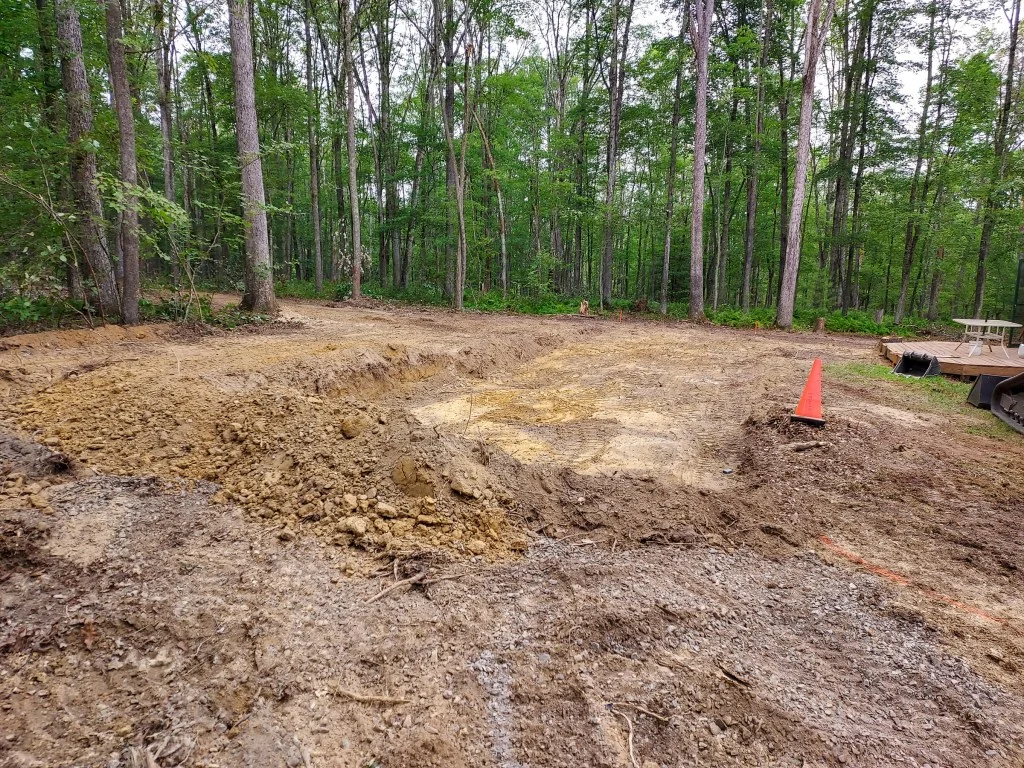
It helps to see what each of those line items looks like in practice on a lot around here. A wooded acre on a moderate slope in the Haw Creek area, cleared for a homesite with stump grinding, chipping of the smaller material, and haul-off of the larger logs, lands somewhere in the middle of the bands above — not the cheapest, not the ceiling. The same acre on a steeper lot in Upper Hominy, where the excavator has to bench the hillside and build a driveway pad just to work, climbs toward the top of the range. Nothing about the acre changed. The dirt did.
If you're still deciding whether to clear at all, the broader land clearing cost guide walks through the national and regional ranges so you have a baseline to compare local bids against. It won't tell you your number, but it tells you which bids deserve a second look.
How to keep a clearing bid honest in this market
Three moves protect your wallet on Buncombe County ground:
- Get the water plan in writing. Before you talk price per acre, ask how the bidder will keep soil on the site when it rains. On a slope, that answer is worth more than a discount.
- Price the extras separately. Stump grinding, haul-off, and grading should each be line items. When they're bundled, you can't tell what you're actually paying for.
- Compare against the range, then ask why. If a bid lands far outside the table above, make the contractor walk you through it. Depth to rock and access vary enormously here, and a clear explanation is worth more than a low number that grows later.
One more: ask how the contractor disposes of stumps and root balls. Burying them on-site is sometimes allowed and cheaper than hauling, but if the burial pit is in a spot that will later hold a foundation, driveway, or septic field, the rot will show up as subsidence years down the road. Good contractors keep burial pits away from anything structural and say so up front.
Curious how this stacks up across the region? The county grading cost page shows the dirt-work side of the same project, and the grading cost guide breaks down how site shaping and stabilization are priced separately from the clearing itself.