What the ground under a Buncombe County slope actually is
Drive any ridgeline road out of Asheville and you're looking at the same three materials under the trees: red clay that swells when wet and shrinks when dry, weathered rock that turns from soil to refusal within a few feet, and old fill placed decades ago by someone nobody can name. Every one of those changes what "too steep" costs you. Clay slopes need undercutting and drainage that stays put through wet winters; rock slopes may need drilling and blasting before a single footing is poured; old fill, common on hillsides subdivided in waves, has to be tested because its bearing capacity is unknown until someone probes it. A 30 percent slope over clay is a different project than the same pitch over rock, which is why a single slope number rarely answers the question.
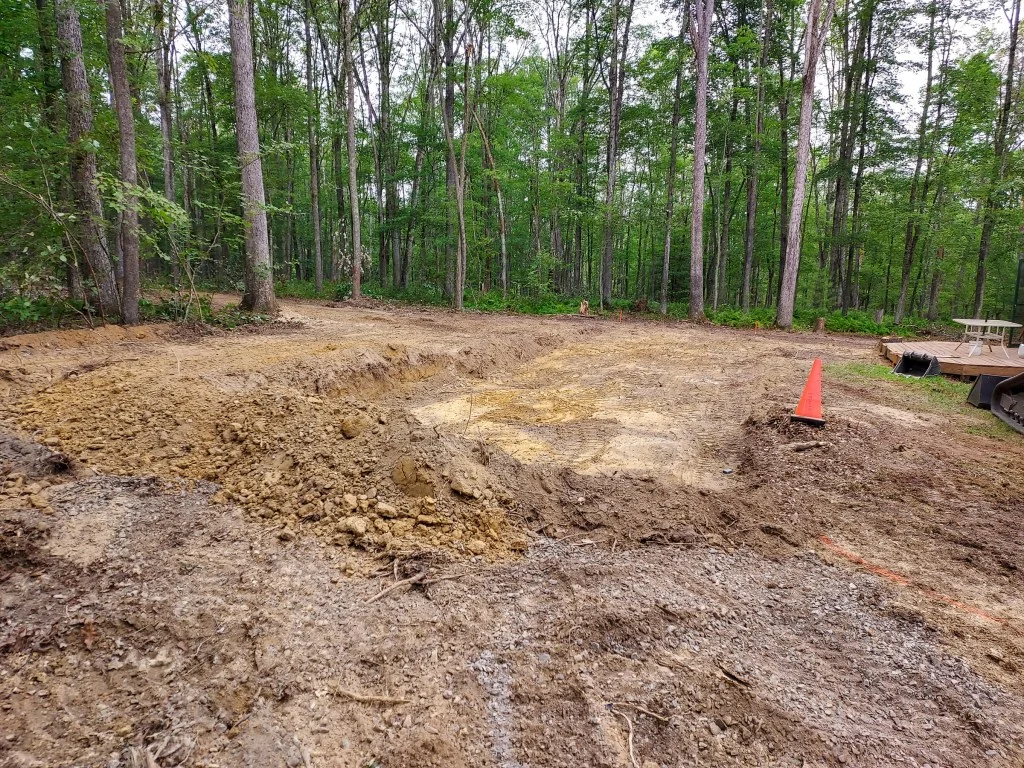
The red clay is the defining headache. It holds water, expands when saturated, and shrinks in dry spells, so a pad cut into it needs to be undercut to stable material and backfilled in lifts that are compacted and tested, not just pushed around with a dozer. Weathered rock is the opposite problem: it looks like dirt until a tooth hits refusal, and then the game becomes hoe-ram or drilling and blasting, which is priced per occurrence and can stop a job cold. Old fill is the quiet risk. On lots platted during the county's earlier building waves, fill was often placed without documentation, and a geotechnical probe is the only honest way to learn whether it will bear a foundation. The NC Building Code Council and NCDOI Engineering Division maintain the residential code that governs footings, foundations, and grading on sloped sites, so the rules for stepped footings and fill placement are already written down — the soil report tells you which rules apply to your parcel.
Terrain here is not uniform, either. A lot off a north-facing slope in the Craggy or Black Mountain area holds moisture differently than a sunbaked south slope near Weaverville or Arden. That aspect affects how fast the clay dries, how the pad drains, and how much of the year the driveway stays firm enough for a loaded truck. None of it shows up on a slope percentage.
The real test: access, septic, and where the water goes
Slope percentage matters less than three practical questions. First, can a loaded truck and equipment reach the pad site? On many Buncombe County lots off winding mountain roads, the driveway is the expensive part, not the house site. A steep run with switchbacks, culverts, and turnout space for a concrete truck can cost more than the pad itself, and if the grade is too steep for a loaded mixer, you're looking at pump trucks and longer pours. Second, where will the septic system go? North Carolina requires a site evaluation and permit before you can place a drainfield, and a slope that sheds water fast may drain too fast to pass — a tested soil profile decides this, not the realtor. The county health department handles that side, and the NC Building Code Council and NCDOI Engineering Division maintain the residential code that governs footings, foundations, and grading on sloped sites.
Third, and most often skipped: where does stormwater go after you cut the pad? A pad carved into a 25 percent slope concentrates runoff that used to spread. The National Weather Service records show how much rain this region can deliver in short windows, and the federal disaster record — 19 declared events touching this county across 1973-2026 — is dominated by storm and flood events. That history is the honest argument for designing drainage before designing the house.
There's a fourth, quieter question that catches buyers on mountain lots: how close is the buildable area to the property line and the setback? On narrow ridge parcels, the only flat spot may sit inside the setback or too near a slope that can't be disturbed. A surveyor and a site plan resolve that before money changes hands, and they're cheap compared to discovering it during excavation.
What pad work costs on a steep Buncombe County lot
Prices vary with access, rock, and how much dirt has to move. These are realistic regional ranges for planning, not quotes:
| Scope | Typical range |
|---|---|
| Clearing and grubbing, easy access | $4,000-$9,000 |
| Building pad cut and fill, moderate slope, red clay | $18,000-$35,000 |
| Pad with undercut and engineered fill | $30,000-$55,000 |
| Rock excavation or blasting, per occurrence | $8,000-$30,000+ |
| Retaining wall, engineered, per linear foot | $50-$120 |
| Driveway grading and culverts for a long steep run | $12,000-$45,000 |
| Erosion control and drainage plan installation | $3,000-$12,000 |
The full walkthrough lives in the steep-lot house pad guide, and the pad-cost page covers how line items get built. For lower-pitch sites, the framing in building pad cost and the sequencing in site prep and building pads apply directly. Erosion control deserves its own line because this county enforces it: a disturbed slope here has to be stabilized before the next rain, and silt fence, diversion ditches, and a temporary seed plan are part of the job, not an add-on. Skip them and you can spend the savings on a cleanup order.
One more cost most buyers don't see coming: hauling. A cut that produces surplus dirt has to go somewhere, and on a narrow mountain lot there's no place to push it. Trucking spoil off-site, or building a fill bench to keep it, both cost money and both change the pad design.
When engineering stops being optional
On flat ground you can often build from a standard detail. On a Buncombe County slope, a licensed engineer becomes part of the team once retaining walls exceed a modest height, once you're placing engineered fill, or once a footing has to step down a grade. North Carolina requires a licensed general contractor for projects above the statutory threshold, and the North Carolina Licensing Board for General Contractors publishes those thresholds — worth checking before you hire anyone who says the work is "too small" for a license. HUD's guidance on site and foundation conditions (hud.gov) is also a reasonable plain-language check on what a proper site investigation should include.
Plumbing and utility work on these sites carries its own licensing rules, and the North Carolina State Board of Examiners of Plumbing, Heating and Fire Sprinkler Contractors is where that's verified. On a steep lot the utility trench itself is a grading project: water and sewer lines running down a slope need bedding and support, and a failed trench can undermine the driveway above it.
How to find out before you buy
The cheap test is a walkover with someone who grades land for a living and a look at the county soil survey for your parcel. The honest test is a geotechnical probe: a few test pits telling you whether you're on clay, rock, or fill, and what it will bear. That typically costs a fraction of what a surprise during excavation costs. If the seller has no site plan and no septic evaluation, treat the lot as unpriced risk until both exist.
Bring the right questions to that walkover. Ask where the driveway will enter and at what grade, whether the septic evaluation has been done and what it found, where the cut will leave a steep face that needs a wall, and where the stormwater will go once the pad is carved. A seller who has already done the soil work and holds a permit is handing you a known quantity; one who hasn't is selling you the excavation surprise. For context on how much the pad itself should cost once the ground is understood, the ranges in the building pad cost page and the step-by-step in site prep and building pads are a reasonable sanity check on any contractor's number.