What Etowah lots do to an excavator
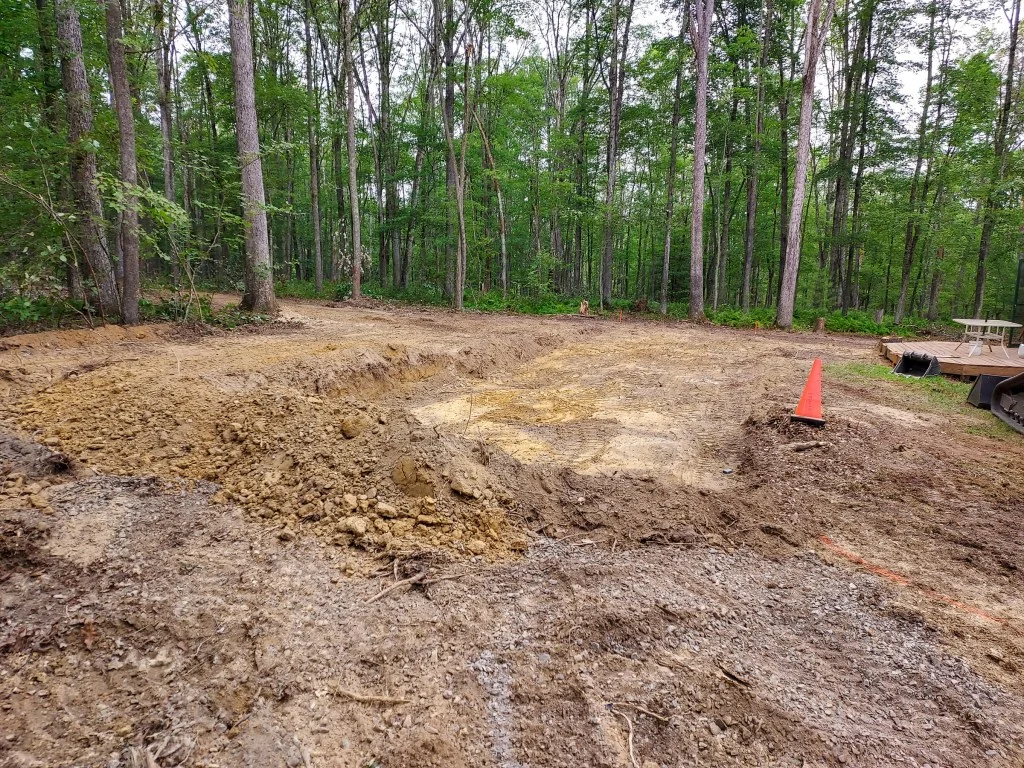
Etowah is not Asheville. Where the city's jobs climb cut-and-fill ridges off Town Mountain or Beaucatcher, this side of Henderson County spreads out along the French Broad's old floodplain and the lower benches that rise off it. That changes the work. Lots here tend toward wider frontage, shallower grades, and ground that has been farmed or subdivided rather than blasted. A machine can usually reach the whole footprint — which sounds like easier digging, and often is, until you hit the water.
River-bottom areas around Etowah and the Highway 64 corridor carry a seasonally high water table. Dig a footing trench in a wet spring and you may be pumping rather than excavating. Tighter parcels off Etowah School Road and the older side lanes add a second constraint: the excavator has to park somewhere, swing somewhere, and get a dump truck out without crossing a septic field. Depth and access set the price here far more than slope does.
Look at the plat shapes on the older roads — Brickyard, McKinney, the lanes running off Etowah School — and you see narrow frontages with long, shallow back yards, often pinned against a creek or a fence line. There is no lay-down area, so spoil has to be stacked in the driveway or hauled the same day. On newer subdivision plates the lots are fatter but the building envelope is tighter because of setbacks, and the excavator ends up working between two finished homes with a machine that barely fits. Both scenarios raise the labor line without adding a dollar of visible scope.
The Etowah price picture
Full foundation excavation scopes — dig, spoil handling, and backfill for a house footing or stem wall — land inside the standard band below. Henderson County pricing generally tracks the low-to-middle of it because access is decent and the terrain is gentler than the mountain towns, but wet-ground jobs push toward the top of a row once dewatering and haul-off enter the scope.
| Scope | Typical range |
|---|---|
| Footing trenches only (dig + spoil, single structure) | $1,200–$4,500 |
| Full foundation dig — crawl space or stem wall, good access | $3,500–$9,000 |
| Full basement dig with haul-off | $9,000–$18,000 |
| Dewatering or wet-ground handling (add-on) | Quoted per job; pushes toward the top of the band |
| Underpinning or pier footing excavations (add-on) | Priced per footing within the footing range |
Line-item detail for surrounding jobs lives on the Henderson County cost breakdown. The number to distrust is the one with no spoil plan and no dewatering line — on Etowah ground, both are real questions.
A practical rule Etowah excavators use: if the dirt is going to stay on the lot, the price falls into the low half of a row; if every yard has to leave on a truck, it climbs toward the top. Rock is rarely the problem here — the floodplain is deep alluvium and the benches are weathered clay over saprolite. Water, haul distance, and how far the truck has to back up to the pile are what move the total.
Water table first, machine second
This county's federal disaster record is why local excavators ask about water before they ask about square footage: 16 declared events reach Henderson County across a 1978-2026 span, and the storm-and-flood family dominates that list. Ground that floods at the surface also holds water below it, and a footing poured into a trench that never dried is a footing that will move. The EPA publishes guidance on erosion and sediment control that applies directly to how spoil and runoff are handled on any dig near a waterway or storm inlet.
The practical sequence: probe for water, decide on dewatering, then dig. If the plan is to backfill and grade the same week, a slope and drainage design belongs in the scope — that is grading work, not excavation work, and it should be priced separately by someone who does it daily. Our Etowah grading contractors page covers that side.
On Etowah ground the timing question matters as much as the method. A trench cut in August may sit bone dry; the same trench cut in March can be a flowing ditch by afternoon. If the build schedule is flexible, pushing the dig toward the drier part of the year is the cheapest dewatering strategy there is. If it is not flexible, budget the pumping, the stone, and the extra crew hours honestly rather than hoping the hole stays dry. The National Weather Service forecast is not a substitute for probing the actual soil, but a week of rain ahead of the pour is a trigger to move the schedule, not the concrete.
Who is allowed to take the job
Excavation for a footing is a construction trade, and North Carolina draws a licensing threshold by project value: general contracting above the statutory limit requires a license from the NC Licensing Board for General Contractors. Ask for the license and verify it — a footing dug wrong is not visible once the concrete is in. If the scope touches a private water or sewer line on its way to the dig, that work is separately licensed by the NC State Board of Examiners of Plumbing, Heating and Fire Sprinkler Contractors, and the excavator coordinating it should know that without being told. For anything involving a burn or fuel on site, the Office of State Fire Marshal at the NC Department of Insurance sets the safety rules.
The licensing question is not paperwork for its own sake. An unlicensed operator on a footprint dig has no bond and no board complaint process behind him if a wall line is missed or a trench wall sloughs into a neighbor's yard. On Etowah's older parcels, where property lines are sometimes fenced rather than surveyed, that exposure is real. Ask for the license number, verify it on the board's lookup, and keep a copy of the certificate of insurance showing general liability alongside it.
What a real Etowah excavation quote contains
A quote you can compare shows five things: the depth and width of the dig, where the spoil goes (on-site spread or hauled off, and the haul distance), how wet ground is handled, who provides and compacts the backfill, and whether a separate inspection of the trench bottom is included before any concrete goes in. Quotes that show only a total are not comparable, even when the totals are close.
Ask, too, how the crew protects the septic field, the well line, and any mature trees within the swing radius. On Etowah's wider, flatter lots the machine has room — but the buried infrastructure is older and less documented than on a new subdivision, and a called 811 locate plus a walkthrough with the homeowner beats a surprise every time.
Two more lines worth demanding in writing: the disposal or stockpile location for the excavated material, and who is responsible for the trench if it fills overnight with rain. On a river-bottom lot neither answer is obvious, and both cost real money to fix if they are left implicit. A quote that names those two things is a quote from someone who has dug in Etowah before.