Where the water is actually coming from on an Asheville lot
Most crawl-space calls in Buncombe County come from lots that were cut into a slope, not built on flat ground. The downhill wall is deep in the ground and the uphill wall is shallow, so roof water, driveway runoff, and the neighbor's yard all sheet toward the low side. After a hard rain, that water pools against the uphill foundation and finds the seam where the footing meets the crawl space wall.
The sequence that produces the puddle is almost always the same. Gutters overflow or dump within three feet of the foundation. The yard slopes back toward the house at the uphill wall. A downspout discharges onto a compacted fill pad that pushes water sideways instead of down. By the time you see standing water under the joists, the grading has been failing for years. 19 federal disaster declarations touch this county (1973-2026), and nearly all of them were storm or flood driven, which is why the drainage question has to come before the encapsulation quote.
The first step is not a dehumidifier or a sump. It is confirming the uphill side of the house drains to daylight and that every downspout discharges at least six feet from the foundation, ideally to a pop-up emitter or splash block that sends water downslope. If the yard rises toward the house at any point along the uphill wall, that is the leak, regardless of what the crawl space looks like inside.
The grading fixes that actually move water
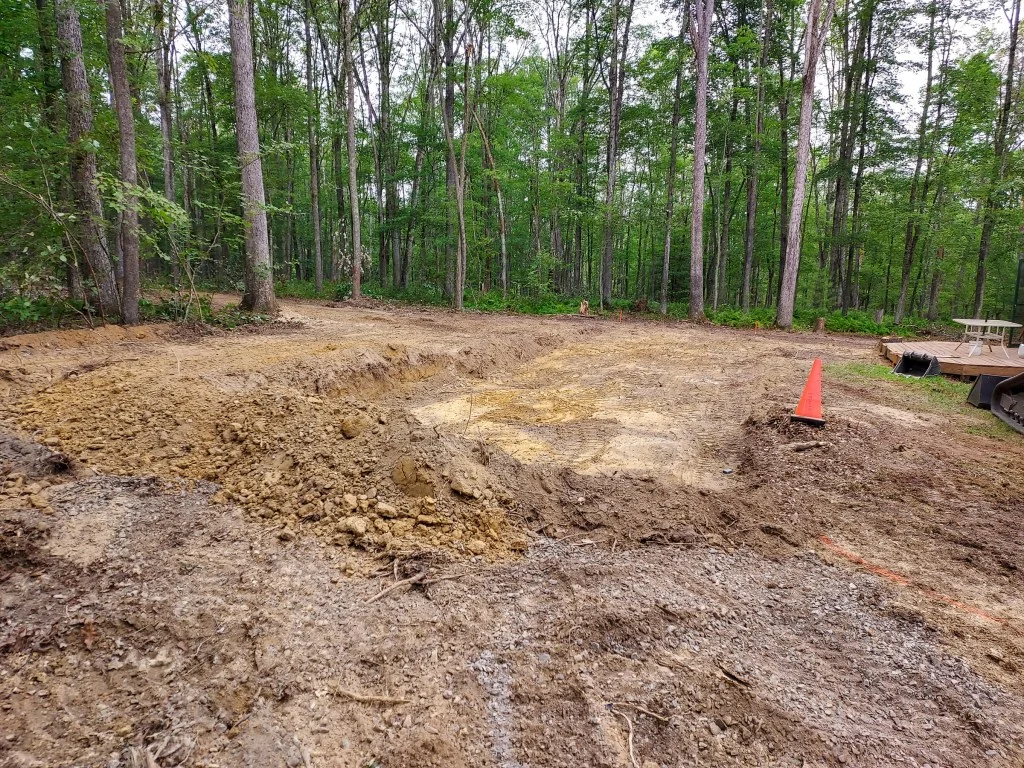
The order of operations matters. Regrade first, then gutters, then subsurface drainage. Regrading means adding compacted clay-heavy soil against the foundation so the surface falls at least six inches over ten feet away from the wall. On a cut lot, that often means a shallow swale along the uphill side to intercept sheet flow before it reaches the footing. A swale is cheaper than a French drain and handles most of the water in a normal year.
Gutter work is the next lever. Every downspout needs an extension that carries water past the splash zone. On a steep lot, run the extension into a buried solid pipe that discharges at a daylight outlet downhill. If you skip the buried pipe, the extension just dumps water at the property line and the next storm pushes it back. This is where the yard slopes toward house drainage guide covers the swale and grade work in detail, and it is worth reading before you call anyone.
Subsurface drainage comes last, not first. A perimeter French drain on the uphill side, sometimes an interior drain tile at the footing, only works after the surface grade is fixed. Installing a French drain under a yard that still slopes toward the house is throwing money into a trench. The drainage and erosion control page walks through how to sequence the work on sloped lots so you are not paying twice.
Scope and price ranges for Buncombe crawl-space water
These are regional ranges for the work as contracted in Buncombe County, not a flat quote. Every site is different and the table is meant to show the spread between a cheap surface fix and a full drainage correction.
| Scope | Typical range | When it is the right call |
|---|---|---|
| Gutter extensions and splash control | $250-$900 | Water is entering right at the wall line and the yard already sheds away |
| Regrade, swale, and compacted soil | $900-$3,200 | Uphill side slopes toward the foundation; no standing water under the house yet |
| Uphill perimeter French drain, surface discharge | $2,400-$6,800 | Grade is fixed but groundwater still seeps at the footing after a long rain |
| Interior drain tile plus sump and discharge line | $4,500-$9,800 | Crawl space sits below the surrounding water table or has a chronic seep |
| Vapor barrier and dehumidification (after drainage) | $1,200-$3,500 | Drainage is corrected and the goal is drying the space out |
Two things push a Buncombe job to the top of a range. First, a slope lot with no daylight outlet within reach of a buried discharge line, which sometimes means a pump instead of gravity. Second, a crawl space with less than eighteen inches of clearance, which makes every trench slower to dig. Neither one is a reason to skip the drainage work; both are reasons to get a real look before you sign.
For a line-item breakdown of a French drain specifically, see the French drain cost page, which separates trench length, pipe, gravel, and outlet work.
Where the grade has to send the water, and why code cares
On a Buncombe County slope lot, the answer is not just away from the house. It is to a point where gravity can take it off the property without pooling against a retaining wall, a driveway, or the downhill neighbor's foundation. That usually means a daylight outlet at the lowest practical point of the lot, and on some properties it means a dry well or a pump basin when no gravity outlet exists within a reasonable trench run.
The North Carolina Building Code Council and NCDOI Engineering Division treat foundation drainage as a required part of the assembly, not an optional upgrade, and the surface grade requirements exist because water against a footing is a recognized cause of movement and rot. The International Code Council provisions that the state adopts set the minimum fall away from the foundation, and inspectors in this county do look at grade and downspout discharge on new construction for exactly that reason.
If the work crosses into moving a footing drain, adding a sump, or connecting a discharge line to the plumbing system, the trade licensing rules kick in. General contracting thresholds are set by the North Carolina Licensing Board for General Contractors, and plumbing or heating work is separately licensed through the North Carolina State Board of Examiners of Plumbing, Heating and Fire Sprinkler Contractors. Ask which license applies to your scope before the first shovel goes in.
What to do this week if the crawl space is wet right now
Do not encapsulate until the water stops entering. A vapor barrier over a wet floor traps moisture against the joists and accelerates rot. The practical order: clear the gutters, extend every downspout past the splash zone, and get the surface water off the uphill wall. Then shop the drainage repair with the surface work already done, because that removes the cheapest fix from the bidder's scope and forces the quote to address the actual seep.
While you wait for a contractor, run a box fan and a dehumidifier if you have power in the crawl space, and keep a note of how high the water gets after each storm. The height and the timing tell the contractor whether you have a surface-water problem or a groundwater problem, and those two take different fixes. The National Weather Service outlook for the Asheville area is worth checking before you schedule work, since a wet pattern changes the grade and drainage behavior you are trying to correct.