The one-acre line that decides your permit path
Mills River sits in Henderson County on ground that alternates between broad French Broad river-bottom flats and hardwood ridges climbing toward the Pisgah front, and that mix is exactly why the one-acre threshold matters here. Under North Carolina's erosion and sedimentation rules, disturbing one acre or more (or any amount within a protected buffer near a waterway) pulls your project into the state permitting program, with a written erosion control plan, site inspections, and mandatory ground cover before winter. Below one acre, most single-home pads and drives fall under local county review instead.
That single number changes budgets more than any machine choice. A 0.6-acre house pad is a grading job. A 1.3-acre pad-and-drive with a pond outlet is a permitted earth-disturbance project, and the plan preparation, silt fence, and stabilization line items ride on top of the dirt work itself. The NC Licensing Board for General Contractors applies its own threshold: once a project crosses the state's cost line for improvement work, the contractor on it needs the right license class. Ask which side of both lines your job lands on before you compare bids.
In practice, the acreage calculation itself trips people up. Disturbed acreage counts everything the equipment touches: the pad, the drive, the septic field cut, the temporary staging area where the dirt pile sits for a week. A lot listed at 0.9 acres in the county records can easily present as 1.1 acres of disturbance once the driveway apron and a utility trench get included. Contractors who regularly work the Banner Farm and Highway 280 corridors flag this before mobilization because retrofitting an erosion plan mid-job delays inspections and stalls the pad.
The permit path also changes who carries responsibility. On a permitted job, someone has to own the erosion control plan, install silt fence and inlet protection, call for inspections at the right stages, and keep the ground-cover schedule honest through winter. On a sub-acre job, those obligations mostly shrink to the contractor's own judgment and the county's review.
What Mills River terrain does to a grading scope
The town's housing pattern explains most of its grading calls: new builds on cut-and-fill ridge lots off the Highway 280 and Banner Farm corridors, small horse and hobby-farm parcels where the barn pad has to drain away from the house, and river-bottom properties that need grade lifted rather than dug.
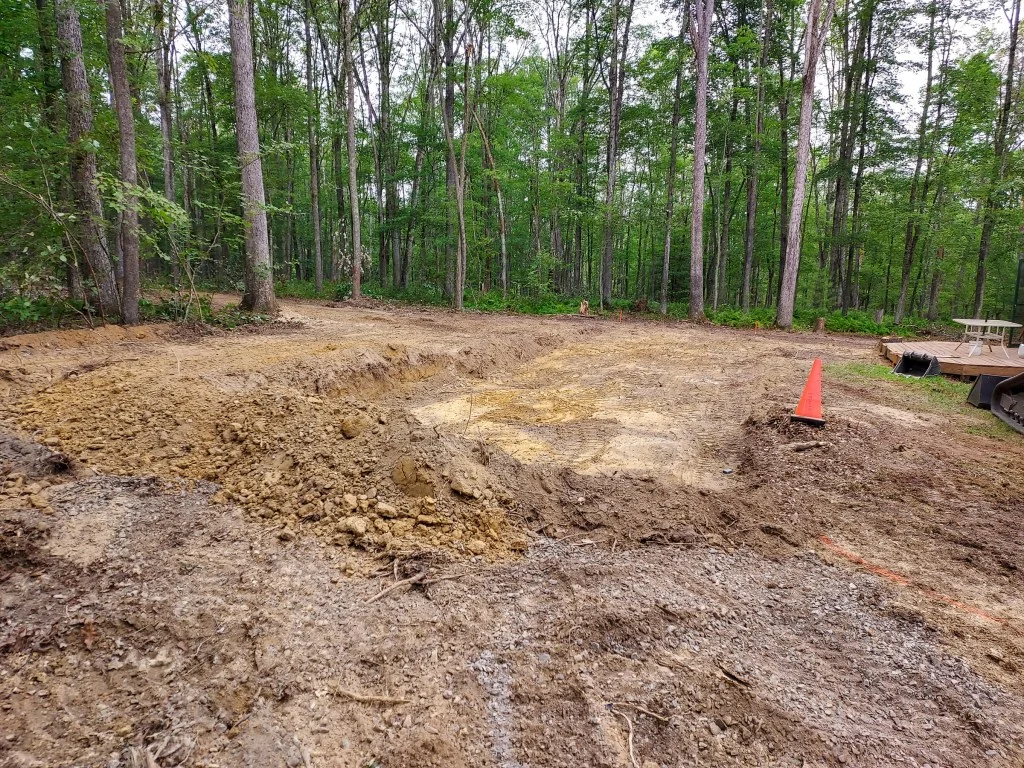
Ridge jobs run heavy on cut-and-fill: you move the top of the hill to build the driveway, then the question becomes how the fill is compacted and where the uphill water goes once you've changed the flow. A driveway cut into a 15 percent slope above the French Broad valley isn't a scrape and push; it's a benched cut with a culvert at the low point and a crown that sheds water off both shoulders before it reaches the hill. Bottomland jobs run the opposite direction: laser-level pads, positive fall to a daylight point, and often a swale that didn't exist before. The federal record backs up the drainage focus: 16 declared events have touched this county across 1978-2026, with storm and flood families dominating. None of that history honors a pad that ponds.
Hobby-farm parcels add their own wrinkle. A barn pad for horses has to drain to a high-traffic area that stays firm in wet weather, and the grade around a run-in shed or arena has to move water off the footing without washing it into the neighbor's pasture. These jobs often cover a bit more ground than a house pad but disturb less per square foot because the finish grade can follow existing contours more loosely than a building pad with footings.
Grading prices by scope in this county
Residential grading in this county typically runs $1,200 to $5,500 for a standard lot, with most homeowners settling near $2,800; mountain lots with rock or heavy fill can push past $8,000. The working table:
| Scope | Typical range |
|---|---|
| Regrade small lot, restore positive fall | $1,200 – $2,200 |
| Driveway cut, culvert, and crown | $1,800 – $3,500 |
| House pad, standard lot, under one acre | $2,400 – $4,200 |
| Full site cut-and-fill with drainage | $3,500 – $5,500 |
| Steep or rocky lot, heavy fill, engineered pad | $5,500 – $8,000+ |
| State erosion permit overhead on 1+ acre | Adds design, silt fence, stabilization line items |
See the full Henderson County grading cost breakdown for line-item detail, and the grading and excavation guide for how scopes get built.
Where bids diverge most in this county is rock. Ridge lots off the Highway 280 side routinely turn up weathered schist and quartz stringers close to the surface, and a bid written without a rock clause can double once the first bucket hits refusal. The same is true of imported fill. A pad built on a cut-and-fill bench needs fill compacted in lifts, and clean structural fill trucked in from off-site carries a per-load cost that varies with the distance to the nearest quarry. A turnkey bid gets the contractor to own those unknowns; an hourly bid offloads them to the homeowner.
Drainage line items sit between the two extremes. A short swale and a daylight cut at the property line is cheap. An underground French drain with gravel and perforated pipe running a hundred feet downhill is a different number, and the bid should name which one you're buying.
Water is the whole job, not a line item
Every grading conversation in this town comes back to where runoff goes after the machines leave. A pad that falls toward the house, a driveway that dumps onto the county road, a fill slope with no stabilization before the next rain: those are the failures that show up as foundation calls later. The National Weather Service flood and storm outlook for mountain counties is a reasonable reminder of how fast a freshly cleared slope can move water.
The fix is sequencing: rough grade with the drainage plan in hand, cut swales and daylight points early, stabilize bare ground before winter rather than after. If your property has trees and stumps in the way of that sequence, handle them first. The land clearing in Mills River NC page covers how clearing feeds directly into a clean grade.
Two site-specific habits worth naming. First, on river-bottom parcels near the Mills River and French Broad confluence, the water table can sit high enough that a hole dug in spring fills overnight. Grading there is as much about raising a pad above seasonal saturation as it is about moving dirt. Second, on ridge lots, the uphill neighbor's runoff is usually the one that surprises homeowners. A swale cut at the top of a fill slope intercepts that water before it crosses the pad, and it costs far less to cut during initial grading than to add after the yard is in.
Getting a usable bid on a mountain lot
Three questions separate real bids here. First: is the price per-hour with materials separate, or a hard turnkey number that includes rock? Rock in these ridges is common enough that a bid without a rock clause is guessing. Second: does the scope state who owns the erosion control plan and who inspects it for a one-acre-plus job? Third: where does the finishing grade daylight? The bid should name the off-site point, not just promise "positive drainage."
On the environmental side, any work that touches stream buffers or wetlands in the river bottoms brings in another layer of review. The EPA and HUD both publish homeowner-facing guidance on floodplain and wetland considerations that applies directly to Mills River bottomland parcels. Ask before you dig, not after.
One more bid-comparison habit: ask each contractor to walk the property with you and point out where the water comes from in a heavy rain. The contractor who can name the uphill source, the low point, and the daylight destination is usually the one whose bid will survive the first storm. The one who only quotes a number for the pad is quoting half a job.
For properties inside the town limits versus the surrounding county, review authority and inspection timing can differ even when the dirt work is identical. A contractor who works Mills River regularly knows which office signs off and roughly how long that queue runs, and that familiarity is worth factoring into the schedule.