The order of operations on a Maggie Valley pad
On flat ground, a building pad is a single phase: strip, cut, fill, compact. In Maggie Valley it's a sequence, and the sequence is the job. It starts with access — a temporary construction entrance stable enough for a loaded tri-axle, which on a Soco Road side slope may mean a short haul road goes in before the excavator ever touches the homesite. Then comes clearing and grubbing, then the cut into the hillside, then the fill lift built back out, then compaction testing, then drainage, then the driveway tie-in. Each step waits on the one before it, and weather in Haywood County sets the pace between them.
That's why a pad that would take four days in the flatlands takes one to three weeks here — and why the honest answer to "when can you start" is a sequence question, not a calendar question. In the winter months, ground that stays saturated won't compact to spec no matter how many passes a roller makes, so the crew will stop rather than bury a problem under a slab.
What the terrain actually does to the price
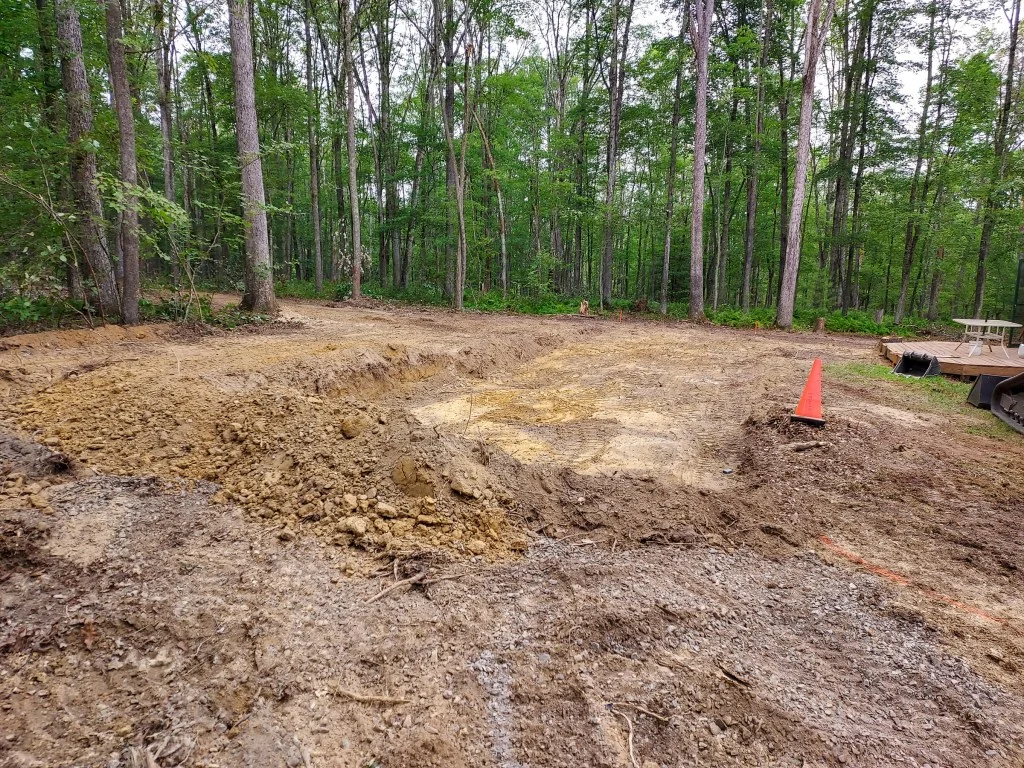
Haywood County ground runs from valley floor near Waynesville up through grades that surprise people who only saw the listing photos. A homesite off a Maggie Valley ridge road is usually a cut-and-fill bench: part of the pad is native soil you excavated, part is engineered fill you built back up, and the transition between them is where the money and the risk live. Rock is the other variable. When a cut hits weathered rock or a seam that won't rip, the machine hours climb fast and the pad budget follows.
Expect these line items to move the number more than anything else: how much cut and fill the bench needs, whether rock removal is by ripping or hammering, how long the driveway cut runs, and whether retaining is needed to hold the uphill side. The Haywood County grading cost breakdown lays out the working ranges so you can match them to your own slope before anyone walks the lot.
Scope-to-price table for a Valley homesite
The ranges below sit inside the region-wide band for residential pads; steep, wooded, or rocky ground pushes a job toward the top of it. Treat any quote that lands well under the low end for your scope as an incomplete bid rather than a bargain.
| Scope | Typical range | What drives it |
|---|---|---|
| Simple flat-lot pad, easy access, minimal clearing | $3,500 – $6,500 | Stripping depth, haul-off volume |
| Sloped lot with moderate cut and fill, driveway cut included | $6,500 – $15,000 | Cut/fill balance, drainage, compaction |
| Steep, wooded, or rocky lot with retaining or rock removal | $15,000 – $30,000 | Rock method, retaining, long access |
| Site prep beyond the pad (utilities trench, septic area, final grade) | Quoted per scope | Scope overlap with the pad build |
Pricing like this is one reason to read a bid line by line, not just at the bottom. The full site prep and building pads guide covers what a complete scope includes so you can tell the difference.
Permits, inspections, and who can legally take the job
Grading and fill on a building site in Haywood County touches more than one rulebook. Erosion control and a grading permit apply once disturbance crosses the state threshold, and the pad itself has to be built to a standard an inspector and a foundation contractor will both accept — compaction documentation is not optional paperwork here, it's what protects the slab you're about to pour. North Carolina's general contractor licensing thresholds, set by the NC Licensing Board for General Contractors, decide whether your job requires a licensed GC, and any work that connects to water or sewer lines brings the state plumbing and heating licensing board into the picture as well.
Before you sign, ask three things: who pulls the erosion and grading permits, who documents compaction, and what the plan is if the cut hits rock. A crew that answers all three without reaching for the phone is a crew that has built pads on this terrain before.
Water, weather, and the long view of a finished pad
Federal disaster records explain why drainage gets designed in, not added later: 19 declared events touch this county across 1973-2026, largely storm and flood family. A pad cut into a Valley hillside is a water-management project as much as an earthmoving one — surface water has to be routed around the bench, not across it, and the uphill neighbor's runoff has to go somewhere other than your fill. The National Weather Service outlook matters to scheduling too, since saturated fill won't compact and a frozen subgrade won't either.
When you're comparing contractors, the Maggie Valley grading contractor list is the right starting point, but the real filter is the site visit. A crew that walks the slope, talks about where the water goes, and asks what the foundation plan calls for is doing the job in the right order. One that quotes from the truck is quoting a different job than the one you own.