Every Biltmore Forest lot has a water story before the first tree falls
Most of the wooded acreage in Biltmore Forest sits on ground that already has an opinion about where water goes. The town occupies rolling terrain south of Asheville in Buncombe County, stitched with small branches that feed the French Broad drainage, and many parcels back onto a creek or a designated stream buffer. Clearing a site here is less a tree job than a drainage job: the minute you open a canopy and scrape duff off a slope, you have changed where runoff lands. The first planning question is not stump count but where the grade has to send stormwater — around the build pad, into a swale, and to a lawful outfall without pushing mud onto a downhill neighbor.
The county's disaster record makes the point. 19 federally declared events touch this area across 1973-2026, heavily weighted toward storm and flood family. A lot that sheet-drains water clean today is one unpicked log pile and one bare slope away from cutting a gully through somebody's drive.
The housing character reinforces the same reality. Biltmore Forest is an established, low-density town of large wooded parcels and long private drives, not a subdivision grid. That means fewer shared storm inlets and more reliance on each lot's own grade to move water. When a neighboring drive crosses your low corner, the finished grade on your side is not just your problem — it is the neighborhood's.
Soils in the area add a second layer. Much of Buncombe County's upland carries clay-heavy subsoils that shed water quickly when compacted and absorb it slowly when vegetated. Strip the vegetation and the same slope that once soaked a storm now delivers it, in volume, to whatever sits below. Any clearing plan that ignores this is planning to redo the work after the first heavy rain.
What actually drives the price
Clearing quotes swing on four things: how thick the stand is, how steep the ground is, whether stumps get ground or pulled and hauled off, and how much dirt has to move to make water behave. On a gentle interior lot with scattered hardwoods, clearing and rough grading stay near the bottom of the band. On a sloped parcel down to a branch edge, with mature trees, stumps to grind, silt fencing at the buffer line, and a couple of daylights to build, the number climbs fast. Firewood and marketable timber can offset some cost, but treat that as a deduction, not the basis for a scope. See the Buncombe County grading cost table for the line items that layer on after the trees come down.
Three cost drivers deserve their own paragraph because they are the ones owners underestimate. First, stump volume. A lot with a hundred mature hardwoods spread across an acre is a different machine day count than a lot with forty. Stumps ground and left in place cost less than stumps pulled and hauled to a Buncombe County disposal site. Second, buffer distance. On parcels that touch a designated stream buffer, silt fencing, a tree-save limit, and slower work near the edge all add line items. Third, haul-off. Biltmore Forest is an established town with narrow private drives and low tree canopies in places, so equipment access and debris trucking can add time that a wide-open county lot would not see.
Timber value is real but rarely decisive. A mature white oak has value to a mill; a mixed hardwood stand with limbs and tops does not clear enough to change the plan. Owners who expect the sale of trees to fund the clearing are usually disappointed, and a contractor who promises it is overselling.
Scope versus realistic price range
Ranges below are honest planning bands for wooded Buncombe County lots, not quotes. Access, slope, and buffer distance move every line.
| Scope | Typical range |
|---|---|
| Brush, saplings, and understory only (light clearing) | $750–$3,500 |
| Selective clearing, stumps ground, debris hauled (moderate lot) | $1,500–$6,000 |
| Full clearing with stump removal and rough grading, gentle lot | $3,500–$9,500 |
| Full clearing plus cut-and-fill, drainage corrections, buffer protection on a sloped lot | $8,000–$12,000 |
Because Biltmore Forest is an established town with its own development expectations, verify the permitting path and any tree or buffer rules before a machine arrives — general-contracting thresholds for site work are described by the NC Licensing Board for General Contractors, and erosion-control rules follow the state framework at NC OSFM / Building Code Council. Getting the approval sequence right is cheaper than correcting it later.
Two scopes that owners often conflate are general land clearing and site prep for a build. Clearing removes vegetation and typically stops at bare ground. Site prep includes the finished grade, the drainage plan, and often the driveway cut, the utility trench path, and the erosion-control install. On a Biltmore Forest parcel, the correct sequence is almost always to price them together, because the clearing limits are drawn from the finished grade, not the other way around.
Grade shapes the clearing plan, not the reverse
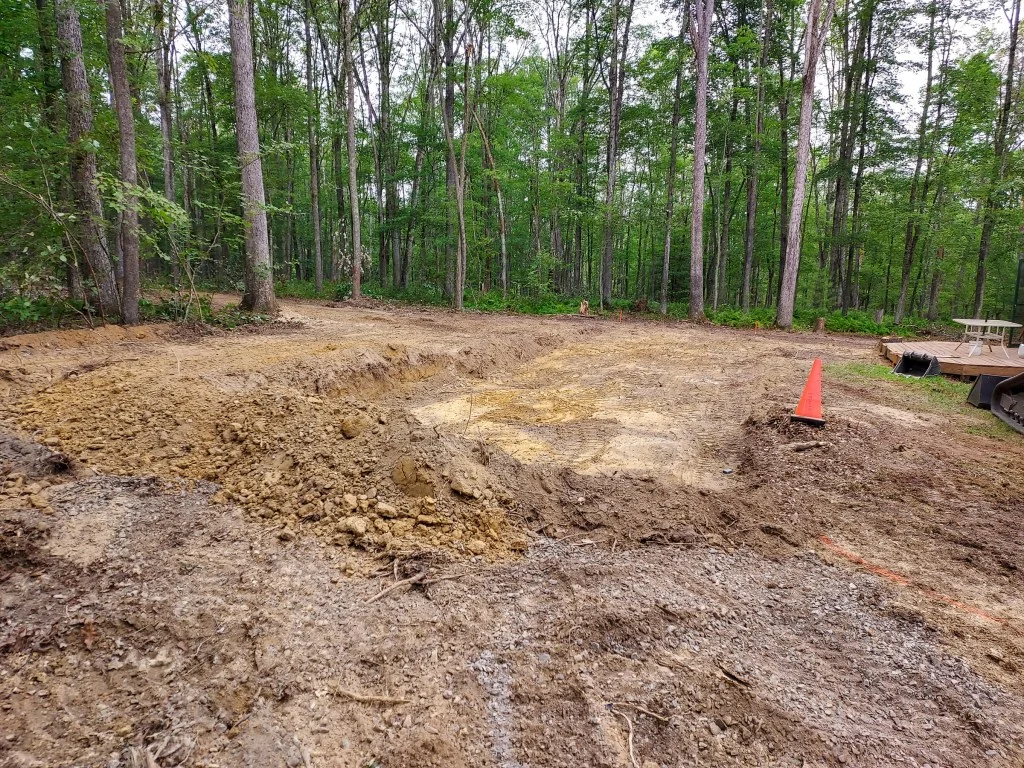
The sequence that works on these lots: walk the site, mark what stays, decide the finished grade, then cut trees to fit that grade — never clear first and figure out the water after. The build pad needs positive fall away on all sides; a swale or shallow ditch carries roof and surface runoff to a legal discharge; a silt fence protects the branch edge at the buffer. If the finished grade can't be achieved without a retaining wall or a bigger cut, that cost belongs in the plan, not in a change order after the trees are gone. An experienced Biltmore Forest grading contractor should be able to show you the finished-grade concept before touching a tree.
On the terrain common to this town — rolling slopes with a fall line that often runs toward the branch at the rear or side — a single missed swale is the difference between a dry foundation and a wet one. The right plan typically establishes the pad elevation first, sets a positive fall to a daylight, and only then marks the tree-save boundary so the equipment has a defined working corridor. On steeper parcels, matting or a temporary crossing may be needed to keep the machine off the buffer edge entirely.
Owners also need to think past construction. A bare, freshly graded slope in Buncombe County will not stay bare. Temporary stabilization, seeding, or mulch on any exposed ground before the next rain event is not just a compliance item — state erosion-control rules under the building code framework published by NC OSFM treat it as a requirement of the work itself. The cost of a failed slope dwarfs the cost of the seed and straw.
Hiring on a wooded, buffered lot
Ask three questions. First: how will they protect the stream buffer and any trees you're keeping — silt fence, designated limit, matting? Second: what happens to stumps and debris — ground in place, hauled, or burned (and is burning allowed here)? Third: do they grade to a finished elevation and leave you a drainage plan, or just push dirt around? State erosion-control requirements are administered under the building code framework published by NC OSFM; the contractor should already know the sequence. Most of the failure stories in this trade aren't about the clearing — they're about water finding the cut slope a season later.
Two more checks are worth the five minutes. Confirm the contractor carries the general-contracting credentials the scope requires for site work under the NC Licensing Board for General Contractors. And ask for the erosion-control sequence in writing: what goes in first, what stays until stabilization, and who inspects after a storm. A contractor who cannot describe that sequence has not done many Biltmore Forest lots.
Finally, get the tree-save and buffer boundaries in the contract, not in a handshake. On a lot that backs to a branch, one unmarked machine pass into the buffer can turn a clean job into a mitigation project. Clarity up front is what separates a smooth clearing from a season of correction.