Where your Weaverville clearing quote actually comes from
A clearing estimate is not one price, it is five or six stacked ones. On a typical Weaverville lot, the line items are: mobilization of equipment up a driveway that may not fit a full-size machine, felling and bucking, stump grinding or extraction, hauling off the debris, rough grading of what is left, and any erosion control that has to be in place before the first rain. Ask for each of those as a separate line and compare bids by line, not by total. A quote that arrives as one round number is hiding which of these is thin.
The other thing that moves a number here: Weaverville is a town of wooded lots on ground that is rarely flat for long. A lot near downtown on a level half acre and a lot two miles out on a hillside cut are the same acreage and completely different jobs. Downtown lots off Main Street tend to be older parcels with mature hardwoods, tight side yards, and a power drop that the crew has to work around. Ridge lots up Reems Creek or along the slopes above town are cut into the hill, so the useful building pad is only a fraction of the deed acreage, and the rest of the clearing is on ground steep enough that a machine has to walk sideways to stay upright. That slope changes the trucking math too: a load that leaves easily from a flat lot can take twice as long to load on a hillside, and the haul-out is often the single largest line on the estimate.
The cost anatomy, in a table
| Scope | Typical range | What drives it |
|---|---|---|
| Brush, saplings, and undergrowth only | $750–$2,000 | Density, access width, whether cut material can be chipped on site |
| Small trees and brush, no stumps | $1,500–$3,500 | Stem count, distance to the burn or dump site, slope |
| Full clearing with stump removal | $2,500–$5,000 | Stump diameter and count, grinding depth, haul-off volume |
| Clear plus rough grade and drainage | $4,000–$8,000 | Cubic yards of cut and fill, culvert needs, sediment control inspection points |
| Steep, heavily wooded acreage | Above $10,000 | Specialized equipment, engineered erosion plans, trucking difficulty |
Run your own list against the fuller Buncombe County grading cost breakdown before you call anyone, so you can tell which bidders are including the dirt work and which are quoting only the cutting. Notice that the ranges overlap. A small lot with heavy stumps can cost more than a larger lot that is mostly brush, and that overlap is why no honest contractor prices this by the acre over the phone. The three numbers that actually drive the estimate are the diameter of the biggest trees in the way, the percentage of the lot that slopes more than a mild grade, and how far a loaded truck has to travel to leave the property.
Stumps are the quiet half of the bill
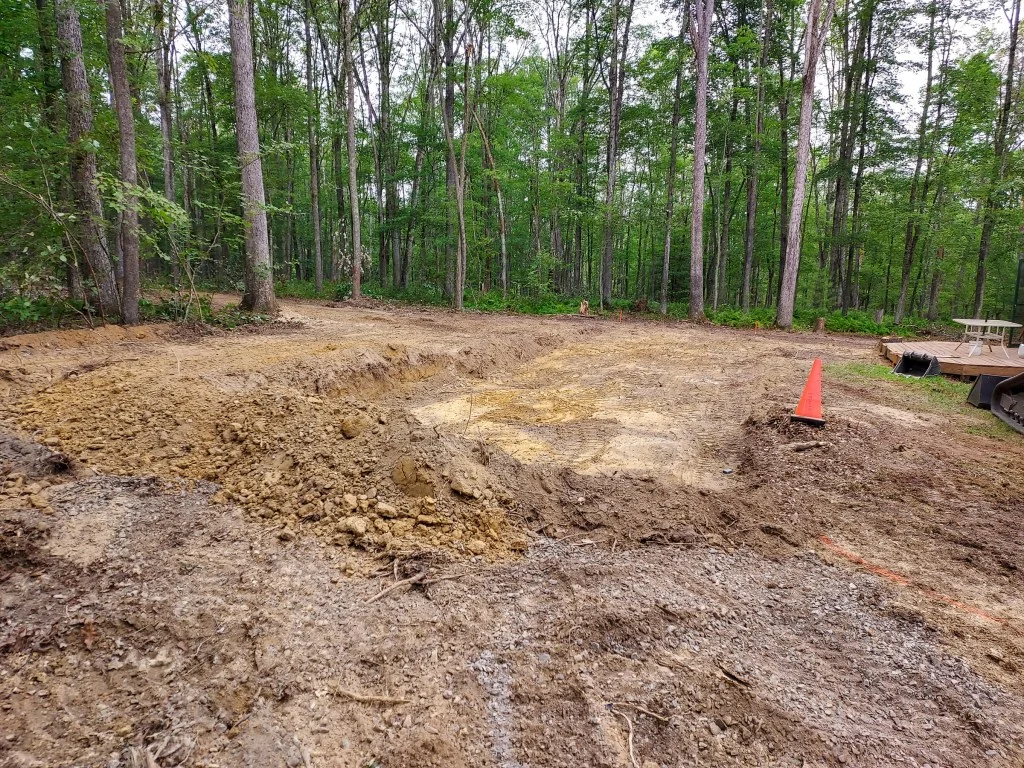
Felling a tree is the visible part. The cost lives below the ground. A grinding that goes eight inches down leaves a root ball that will rot and sink for a decade, which is fine for a lawn and fatal under a slab, driveway, or paver patio. For anything that will be built on, the stumps need to come out or be ground deep, and the holes backfilled with compacted material, not the chips.
Disposal is the second cost. Burning may be practical on some rural parcels out toward the Reems Creek valley or the county line, but it is restricted by season and air-quality rules, and hauling green wood off a hillside lot is slower than it sounds. A hardwood stump two feet across is a different job from a cluster of poplar and pine the wind already dropped, and the species mix here matters. Ask where the debris is going before you compare two bids, because one contractor may be quoting a burn and the other quoting a truck every load, and that difference alone can swing a quote by a thousand dollars or more.
There is also the backfill question. Chips leftover from clearing rot and settle over time, so a contractor who fills stump holes with chips is selling you a lawn that will dip in a few years. Clean fill dirt, tamped in lifts, holds. If your plan includes a shop, a garage, or a home site, ask directly what material is going into the holes, because that is where cheap clearing shows up later as a cracked slab or a sunken corner of the driveway.
Water, slope, and the permit question
Clearing ground in a wet mountain county changes where the water goes. A lot that has drained through leaf litter and root channels for fifty years will sheet off bare soil fast. North Carolina treats erosion control and stormwater as regulated activities once a project crosses size and disturbance thresholds, and grading that touches streams or steep slopes draws more review, not less. The NC Licensing Board for General Contractors publishes where a project stops being something a handyman can legally take on, and the EPA maintains the stormwater and sediment guidance that state rules build from.
That is the practical test for any Weaverville bid: does the quote include a silt fence, a stabilized entrance, and a plan for where runoff leaves the property? If it does not, the cost did not disappear. It moved to your driveway and your neighbor's yard. On these slopes, water leaves fast and it carries soil with it, and a sediment plume that reaches a creek or a road ditch can turn a finished clearing job into a stop-work order and a cleanup bill. Before you sign, ask who is responsible if an inspector flags the site mid-job, and get that in writing, because the answer changes what the job really costs.
Clearing your own lot vs. hiring it out
Small lots and light brush are genuinely doable with a saw, a chipper, and weekends, and there is nothing wrong with that path. The crossover point is stumps and dirt. Excavation work, stump extraction beside a structure, and grading that has to shed water correctly are where the equipment and the liability both jump. If your plan includes a foundation, a driveway, or a septic field, the rough grade has to be right the first time, because every trade downstream inherits it.
Licensed grading contractors in the area are listed through the same board that governs general contracting, and the crews set up for this work are catalogued in our Weaverville grading contractor directory. For a broader view of scope and sequencing, the land clearing service overview walks through the standard phases.
One more local angle: this is a small-town market, and the crews who work Weaverville also work the surrounding Buncombe County lots, so scheduling and references travel by word of mouth. Ask for a job they finished last season nearby and go look at it. Six months after clearing, you can see where the ground settled, where water pooled, and whether the grass came back. That walk-around tells you more than any bid sheet, and in a place where the same crews pass the same lots every week, a contractor's local reputation is the real credential.
Scheduling around a mountain season
Weaverville ground is workable most of the year, but not evenly. Late winter and early spring bring saturated soil that ruts under equipment and turns a two-day job into a four-day one; heavy summer thunderstorms stall crews mid-afternoon. The National Weather Service forecast office at weather.gov is worth checking the week you plan to start. Historically, 19 federally declared events have touched this county across 1973-2026, mostly flood and storm family, which is a useful reminder that bare, freshly cleared ground is at its most vulnerable right after the job is done.
The best window in this part of the county is usually late summer into fall, when the soil has drained and the leaves are off enough to see the stems and the ground shape. Clearing in leaf-on season means hiding stumps, rocks, and old fence wire under green, and that is where surprise costs come from. Scheduling also matters for the lot next door: work on a hillside above a neighbor is a conversation worth having before the first machine arrives, because noise, dust, and runoff all travel downhill, and in a town this size the neighbor you disturb is likely someone you will see at the store the next week.