Where water lands on a Marshall lot, and where it must leave
Drive the county roads between Marshall and Mars Hill and the pattern shows itself: cut banks rising on the uphill side, a bench of flat ground where the house or driveway sits, and a drop on the other side toward the French Broad or one of its feeder creeks. Water does not politely stay on the hill it fell on. It sheet-flows down the cut, ponds against the uphill foundation wall, and — if the excavation plan was drawn for a flat lot — runs straight toward whatever sits below.
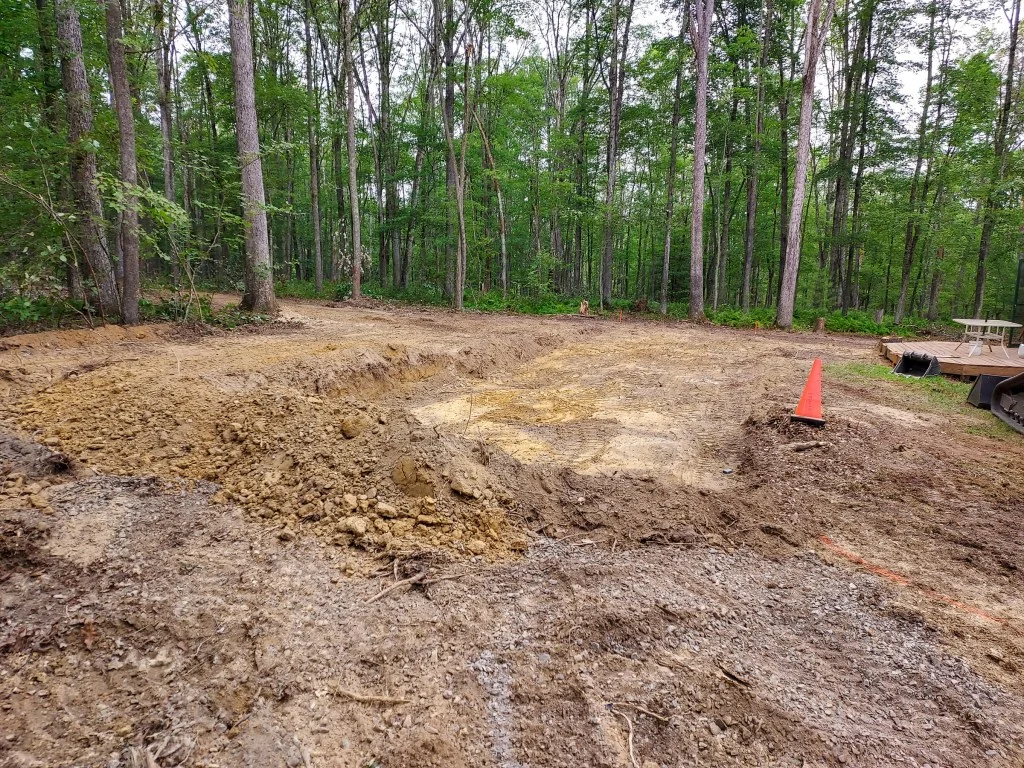
So the first job on nearly every Madison County dig is not removal, it's redirection: shaping the bench so it falls away from the structure at roughly a six-inch drop over the first ten feet, tying the driveway crown into a defined swale, and giving the cut-bank water a path that does not cross the building pad. The excavation contractor who starts by asking where the water goes comes before anyone talks about machine hours. The federal record backs this up: 21 disaster declarations touch this county (1978-2026), overwhelmingly storm and flood events, and each one tested the drainage assumptions of every lot it crossed. The National Weather Service river gauges at Marshall are not decoration — they are the reason elevation and grade get checked twice here before a pad is set.
What makes Marshall different from a flatland town is that most buildable lots here were carved out of a hillside rather than graded from level ground. That means the original grade already had a direction before anyone touched it, and the excavation either works with that direction or fights it. A pad cut into a north-facing slope above the French Broad will hold frost and moisture longer than one on a south-facing bench, and the drainage plan has to account for that. The contractors who know this county well will walk a lot and can usually point to the exact spot where water will collect if the grade is left flat — it's almost always the inside corner where a driveway meets a foundation wall, or the low shoulder where a retaining wall ties back to native ground.
What the ground itself does to a bid
Madison County dirt is not uniform, and any honest estimate admits it. River-bottom ground near town is often deep alluvium — easy to dig, quick to cave, and prone to holding water. Ridge ground above the valley is a different animal: clay, saprolite, and rock in layers that turn a two-day footing dig into a week of hammering. This is why two contractors can look at the same lot and quote numbers that differ by thousands, and why the credible one walks it before pricing it.
A working bid separates three things: machine time, hauling, and rock contingency. The last item matters most here. Any quote that treats rock as free is either padded elsewhere or guessing.
There's a middle ground that catches people too — the decomposed granite and saprolite that looks like soft dirt until the bucket hits it and it turns out to be a broken shelf of weathered rock. It digs, but slowly, and the machine has to work the teeth instead of slicing. On a footing dig that was priced as straight dirt, a shelf like that can add a day or more of machine time without any single dramatic event. That's why experienced local operators price footings by the foot and carry a note about unknown subsurface conditions rather than quoting a flat number.
Depth matters as well. A walkout basement on a downhill slope near Marshall can mean a foundation wall fourteen feet tall on the low side, and the excavation has to remove enough material to pour that wall and leave room for backfill and drainage. The overdig and the backfill are real costs that a homeowner looking only at the footprint size won't anticipate. A bid that lists them out is a bid you can trust.
Scope and typical price ranges in Madison County
These are regional bands for site work around Marshall, not a flat rate — access, slope, and rock move every line. The full county context lives in the Madison County grading cost breakdown.
| Scope of work | Typical range |
|---|---|
| Small drainage correction (swale, culvert reset, regrading a wet corner) | $800–$2,500 |
| Driveway cut and gravel base, moderate slope | $2,500–$7,500 |
| Footing and foundation excavation, house-sized | $3,000–$9,000 |
| Full building pad cut, haul spoils off-site | $6,000–$12,000+ |
| Rock encountered beyond soft digging | Billed by hour or by added contingency |
Hauling distance is the quiet multiplier. If spoils can be used on-site as fill, the number drops. If a truck has to run every load to an approved site, it climbs fast. Ask which one your bid assumes.
Access is the second quiet multiplier, and it's the one that surprises out-of-county owners most. A lot on a narrow county road with a tight switchback at the entrance will slow every truck and every machine move. A lowboy trailer that can't make the final turn means the equipment walks in, and walking a machine a quarter mile up a mountain road takes hours. On some parcels off the ridge roads above Marshall, the access cost alone can rival the dirt work. That's not padding — it's the honest reality of a county where the road network follows the terrain instead of the other way around.
Fill balance is the third lever. When a site can use its own cut material as fill under a driveway or pad, the contractor moves dirt once instead of twice. Lots where the cut and fill don't balance — where there's too much cut and nothing to do with it, or not enough material and fill has to be imported — cost more in a way that isn't visible in the plan. A good site plan tries to balance cut and fill on paper before anyone digs. Not every lot allows it, but the effort to try is a sign of a contractor who's done this work in the mountains before.
Licensing, erosion, and the paperwork side
North Carolina draws a licensing line that catches more homeowners than they expect: projects crossing the cost threshold generally require a licensed general contractor, and earthwork attached to a permitted structure usually rides under that. Verify any contractor through the NC Licensing Board for General Contractors before a machine shows up. Separately, if the work disturbs enough ground or sits near a stream or the French Broad floodplain, erosion control and sometimes a permit apply — the county and state take that seriously precisely because of the water history above. For floodplain construction standards and elevation requirements, the EPA and HUD publish the federal guidance local rules build on. A contractor who shrugs at this question is telling you something.
Erosion control on a slope is not a formality here. Silt fence alone rarely holds on a steep cut — the runoff velocity is too high and the fence plugs and fails. Serious site plans in this county use check dams in the swale, a stabilized construction entrance so the county road doesn't get a mud trail, and seed-and-matting on any bare slope that will sit exposed through a wet season. If a plan relies only on a single line of silt fence at the bottom of a cut bank, ask why. It's a reasonable question and the answer should be specific.
The building permit and the grading are usually handled as separate steps, but they intersect. A foundation permit review often wants to see the finished grade around the structure and the drainage plan that carries water away from it. Electrical and plumbing rough-ins follow, and the site has to be in a condition for inspections. That sequencing is part of why site work belongs on the schedule early instead of being squeezed in after a contractor has been chosen for everything else.
Getting a read on a local crew
Three checks specific to Marshall and its surroundings. First, ask whether they have worked a slope with a cut bank above the pad — flat-lot experience does not transfer. Second, ask where the spoils go before you sign, not after. Third, ask how they handle a wet-weather stoppage mid-dig, because in this county that will happen. See our Marshall grading contractors page for how the finishing side of the same job is scoped.
Beyond those three, listen for how a contractor describes the ground. Someone who has worked this county will talk about the difference between river-bottom ground and ridge ground without being prompted, will mention the shelf rock that hides under soft-looking soil, and will know that fall rain can shut a site down for a week. Someone who describes every job the same way is likely describing a template, not your lot.
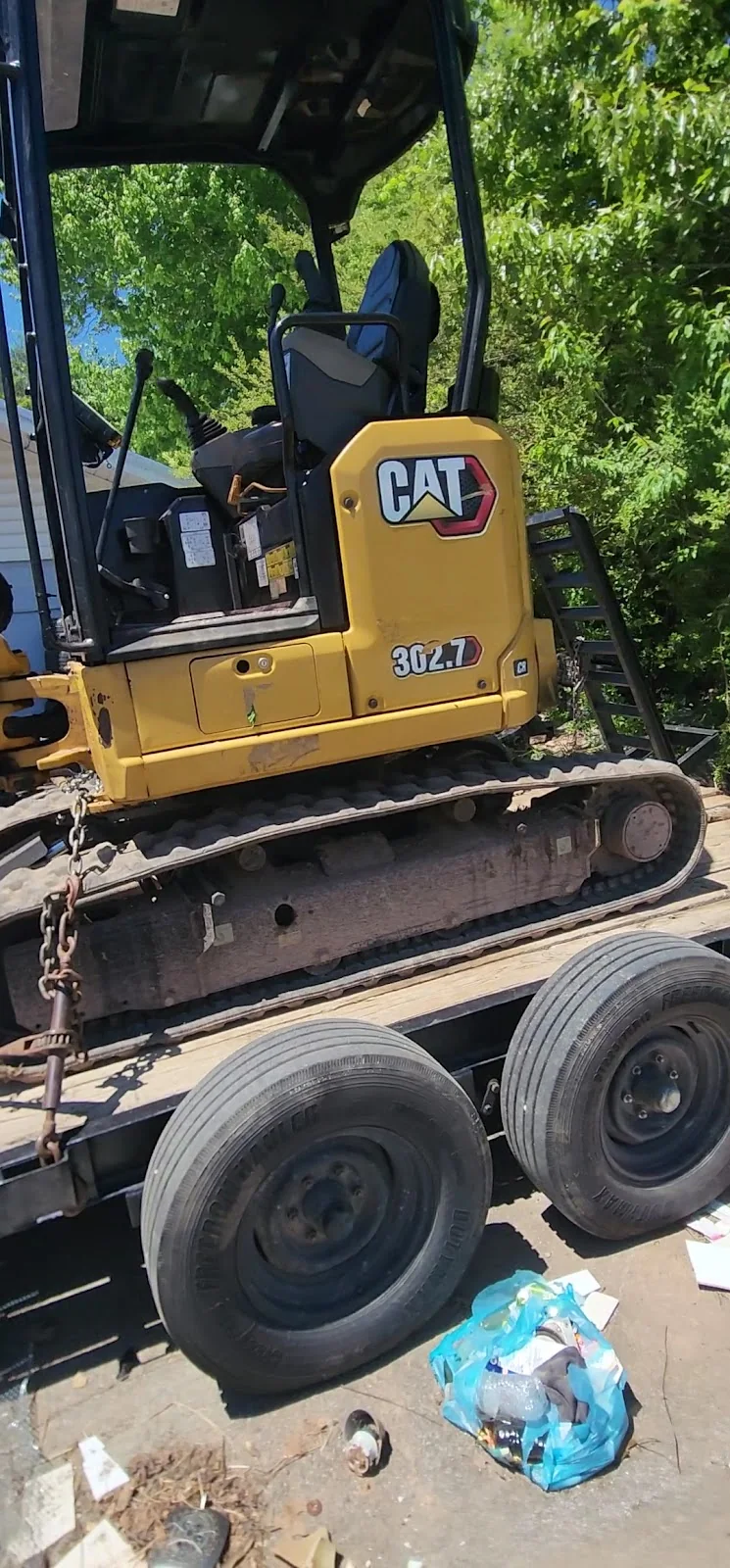
Equipment matters too, though not in the way you might think. The machine that fits the job depends on access. A full-size excavator is fast where it can reach, but on a tight lot above the valley a compact machine may do the same work on a longer schedule. Neither is wrong. What's wrong is arriving with equipment that can't fit the access, or sizing the machine to the bid instead of the job. Ask what they plan to bring and why. A straight answer usually separates the crews that know this terrain from the ones that don't.
Finally, ask about the timeline and what happens if it slips. Site work sets the schedule for everything that follows — the foundation, the framing, the rough-in inspections. A contractor who can talk plainly about weather risk and access constraints is a contractor who has built realistic schedules before. That's worth more than the lowest number on a page.