What Laurel Park's ground does to a pad job
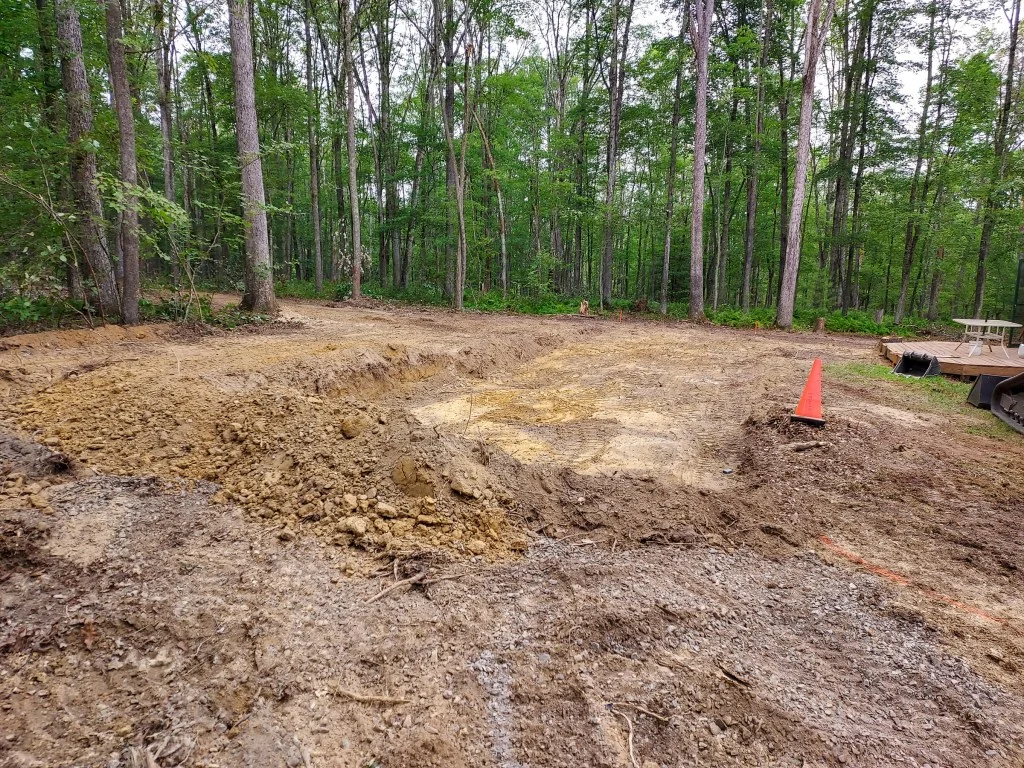
Dig a test hole almost anywhere in Laurel Park and you find one of two things: red clay sitting directly on saprolite and weathered bedrock, or a layer of old fill that someone pushed in when the lot was split off a bigger tract decades ago. The first means the pad has to be cut down to competent material and the cut faces have to hold; the second means someone has to decide whether that fill is dense enough to build on or has to come out. Those are different jobs, and on the same street they can price thousands of dollars apart.
Laurel Park sits in Henderson County just south of Asheville, and this town's lots are typically smaller and more wooded than the big graded subdivisions farther out. That matters for site prep Laurel Park NC: pads here often get carved into a slope under a mature tree canopy, which means stump and root removal, tight equipment access, and an erosion plan that keeps clay out of whatever creek the lot drains toward. On hillside lots off the ridge roads, the uphill cut and the downhill fill face are the whole job. Flat-lot quotes that ignore that configuration are usually missing something.
Red clay, rock, and old fill: how each one prices
Red clay is workable but fussy. It doesn't compact well wet, it pumps under a track machine, and it holds water against a foundation for years. A pad built on clay that wasn't proof-rolled and moisture-conditioned will settle under a slab. Rock is the opposite problem: hard rock in a cut means drilling and hoe-ram time, and that line item is usually the single biggest swing on a Laurel Park pad estimate. Old fill is the quiet one — it looks fine until a loaded truck rolls across and the pad deflects.
The working rule for this county: don't accept a pad price before someone has walked the lot, probed the cut depth, and looked at what the surrounding lots were built on. The mechanics of that first visit are covered in the site prep and building pads guide, and the county-level numbers live in the Henderson County grading cost breakdown. North Carolina's general contractor licensing thresholds, which apply once a job crosses the statutory dollar amount, are set by the NC Licensing Board for General Contractors — worth checking on any large cut-and-fill project.
The price picture for building pads in Laurel Park
These ranges assume a typical single-family lot with reasonable access. Rock, retaining walls, and engineered fill push toward the top or past it.
| Scope | Typical range |
|---|---|
| Light clearing and grubbing, small lot | $2,500-$6,000 |
| Rough grading, cut and fill, no rock | $4,000-$9,000 |
| Full building pad, engineered fill, compaction testing | $8,500-$22,000 |
| Rock excavation (hoe-ram or drill), per day impact | $1,500-$4,500 |
| Retaining wall at cut or fill face | $45-$95 per face square foot |
| Erosion control, silt fence, temporary seeding | $800-$3,000 |
The two rows most likely to move on a Laurel Park job are rock excavation and retaining walls. Both are slope-driven, and this town has more slope per lot than the flatter subdivisions east of Hendersonville. Treat any bid missing those two line items as a bid that hasn't seen the lot yet.
Water, weather, and why pads here fail early
Henderson County has a long federal disaster record — 16 declared events touch this area across 1978-2026, weighted heavily toward storms and flooding. Every one of those pushed water across pads that were graded for a drier assumption. The practical takeaway for a Laurel Park building pad: the finish grade has to move water away from the pad on day one, not after the house is framed. That means positive slope off all four sides, a defined swale or drainage path to a legal discharge point, and gutters designed for the roof you're actually building.
The building code treats site drainage as a requirement, not an option — see the NC Office of State Fire Marshal code enforcement resources for how that plays out in inspections. And because we're in a wet, storm-prone climate, the National Weather Service outlook is worth checking before scheduling a cut: clay that gets rained on mid-grade has to dry before it can be compacted, and that delay is real money.
Hiring a grading crew in this town
Three checks specific to Laurel Park. First, ask how they handle rock discovery: is it a unit price per cubic yard, an hourly rate, or a handshake? Get it in writing. Second, ask whether they run their own compaction testing or bring in a third-party technician — for any engineered fill under a foundation, independent testing is the only proof the pad is built right. Third, ask for references on lots with similar slope and tree cover, not the flattest job in their portfolio. The Laurel Park grading contractor page covers what a qualified local crew looks like, and it's worth reading before you call anyone.