What Woodfin ground does to a pad job
Woodfin sits in a narrow band north of Asheville where the French Broad River flattens out before the ridges climb toward Elk Mountain. That geography gives you two very different kinds of lots on the same street. Down on the river side you're dealing with deep alluvial soils, a high water table, and fill placed decades ago that may or may not have been compacted. Up the hill you're cutting into weathered rock and red clay that sheds water badly once the topsoil is stripped.
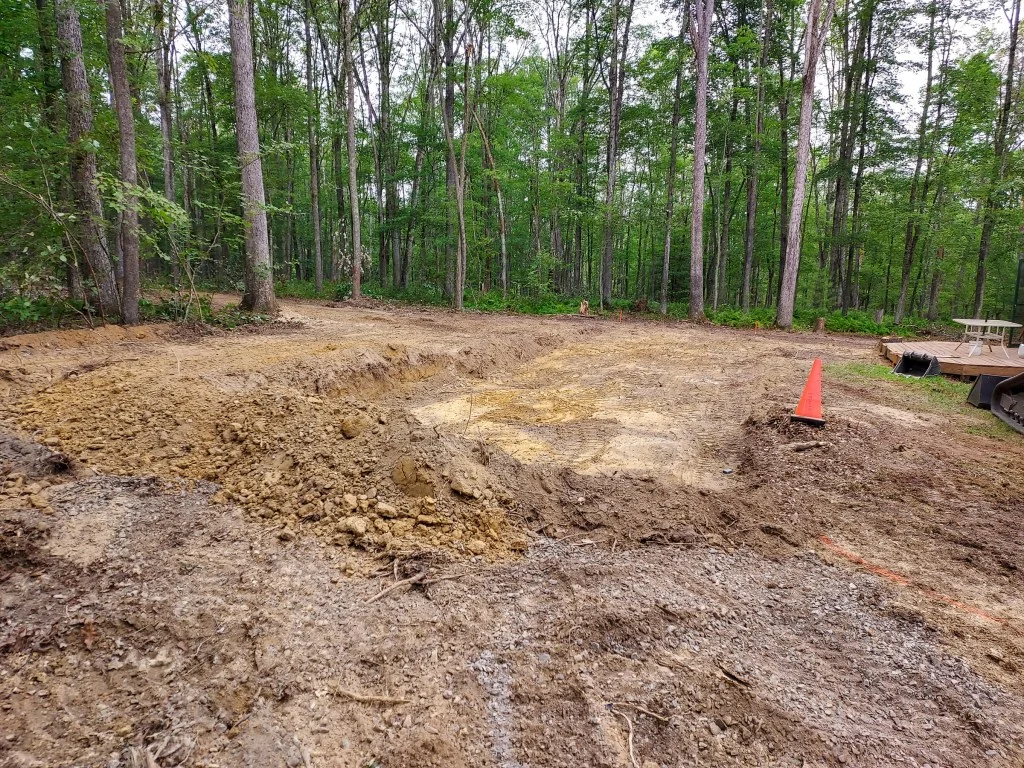
Both lots need a building pad. Neither one prices like a flat cornfield in the Piedmont. The river-terrace lot needs undercut and structural fill; the hillside lot needs cut-and-fill with a bench, a retaining edge, and somewhere for the stormwater to actually go. Get the soil question answered before the first machine shows up, because red clay that looks stable in July can turn into a grease-slick glass slope after a wet October.
Reading a Woodfin lot before you bid it
Three observations decide most of the scope. First, where does the water leave the site? Woodfin's river-terrace lots often drain toward the French Broad with very little fall, which means a pad that's three inches off grade sends water under the slab. Second, what's under the topsoil? Blueschist and weathered granite are both common in this corridor, and the rock line can drop six feet between two adjacent properties. Third, is there old fill? The town grew fast in the mid twentieth century, and plenty of pads were built on uncompacted material.
That last one is the expensive surprise. Fill that wasn't placed in lifts and compacted to a density standard has to be undercut and replaced, or the pad will move for the next twenty years. The International Code Council treats fill placement and compaction as a code requirement with testing behind it, not a preference — and inspectors in Buncombe County will ask for the proof on a permitted structure.
Scope to budget, line by line
Woodfin pad work comes in four layers: clearing and grubbing, cut and fill with compaction, drainage and stabilization, and fine grade for the slab or the gravel. Most homeowners only budget the middle one and are surprised by the ends. The table below reflects realistic regional bands; a rock-line surprise or a deep undercut can push the top row and the bottom row well past these figures.
| Scope item | Typical range | What moves the number |
|---|---|---|
| Clearing, grubbing, topsoil strip | $1,200 - $4,500 | Tree size and count, stump disposal, haul-off distance |
| Cut and fill, house pad only | $3,500 - $9,000 | Cubic yards of fill, import cost, lift-and-compact testing |
| Rock excavation or blasting | $2,500 - $12,000+ | Rock line depth, hardness, distance to structures |
| Drainage, swales, footing drains | $1,500 - $5,500 | Where the water can legally daylight, pipe length |
| Driveway subgrade and gravel | $2,500 - $8,000 | Length, slope, stone depth, culvert needs |
| Full pad + driveway + drainage | $8,000 - $22,000 | All of the above stacking on one tight lot |
The site-prep and pad scope itself is covered in more depth on the site prep and building pads page, and the per-yard numbers behind it live on the Buncombe County grading cost breakdown. Builders should read both before requesting a bid, because the line items that get cut from a cheap quote are always the same ones.
Water management is the whole job
If you take nothing else from this page: on a Woodfin lot, drainage is not an add-on. The federal disaster record tells the story — 19 declared events have touched this county across 1973-2026, and river flooding plus storm runoff dominate the list. A pad that sits six inches too low near the French Broad, or one that sends sheet flow toward the neighbor's foundation, is a problem that will outlive the contractor who built it.
The fix is unglamorous: positive fall away from the structure, a swale or an underdrain where the lot can't get fall, and a footing drain that actually discharges somewhere legal. The NC Office of State Fire Marshal code enforcement side of this matters too — grading and drainage around a permitted structure is inspected, not assumed.
Sequencing the work with your builder
Most Woodfin pad jobs ride on a house permit, so the site work has to finish before the foundation crew arrives and the soil has to test clean before the footing inspection. That means weather windows matter more than most homeowners expect. A wet spring in the French Broad valley can idle a cut-and-fill crew for weeks, and pushing the work through saturated clay does more harm than waiting.
Ask any contractor you call two questions. Will there be a compaction test report on the fill? And who pulls the grading permit and the erosion control plan? In North Carolina the answer to whether a project needs a licensed general contractor depends largely on the value of the work — the threshold and rules are at the NC Licensing Board for General Contractors — but regardless of who holds the license, the pad itself has to be built to a standard that survives the inspection. When you're ready to get real numbers, the crews listed on the Woodfin grading contractors page are vetted for exactly this kind of lot.