Where the water starts on a Buncombe acre
A cleared acre in Buncombe County does not just lose its trees, it loses its roof. Forest canopy on these ridges and coves intercepts a serious share of rainfall and root structure holds the duff layer that soaks up the rest. Cut it, and the same storm that used to filter into the ground now sheets off the slope toward whatever sits below — a driveway, a footer, a neighbor's cut bank. That is the reason a land clearing quote here that stops at the stump grinder is only quoting half a job.
Between the slopes above Haw Creek, the flatter bottomland out toward Leicester, and the cut-and-fill pad sites common on Weaverville hillsides, the county's terrain pushes water fast. The federal record backs up how often that matters: 19 federally declared disaster events have touched Buncombe County (1973-2026), most of them storm, flood, or landslide family. That history is why grading and drainage get priced into the clearing here as one scope.
Before we look at numbers, the short answer on where the grade has to send water is simple: away from any future structure, off the cut slope, and into a stable outlet that will not erode itself into a gully by next spring.
Think about what that looks like on a real lot. On a south-facing slope in Fairview, the roof of the forest is doing more work than people realize. Once it is gone, rain that used to drip slowly off hemlock and oak branches hits bare clay and moves downhill at speed. If your driveway is cut into that slope, the water will find the cut edge first. If your neighbor's house sits below, their cut bank becomes your outlet unless somebody planned otherwise. That is not a hypothetical; it is the pattern across much of the county's hillside development, and it is why the first line of a good clearing bid should be about where water goes, not how many trees come down.
The terrain in Buncombe also varies block by block in a way that flatland counties do not. A lot in Swannanoa might sit on deep alluvium with a high water table, while a lot ten minutes up the road in Black Mountain is on weathered bedrock with almost no topsoil. The clearing scope changes because the drainage answer changes. On the alluvial ground, the concern is keeping sediment out of ditches and streams. On the rocky ground, the concern is that water will run off before it ever soaks in, which means the outlet has to be armored or it will cut. Neither lot can be priced from an aerial photo alone.
What clearing actually costs per acre here
Statewide averages are not much help on mountain ground. Depth to rock, haul distance, and how much material has to move are all local variables, and the ranges below reflect what real Buncombe terrain produces.
| Scope of work | Typical range per acre | What drives it |
|---|---|---|
| Brush and sapling clearing (light) | $1,800 – $3,000 | stem size, understory density, ground slope |
| Mixed hardwood clearing, stumps left | $2,500 – $4,500 | tree diameter, pulp or firewood sell-off, access |
| Full clearing with stump removal and disposal | $3,500 – $6,500 | stump count, burn versus haul, root balls |
| Steep-lot clearing plus rough grading and drainage | $5,500 – $8,500+ | erosion control, cut-and-fill volume, haul distance to a legal site |
Those are working bands, not quotes. Nobody can price an acre before seeing what is standing on it and where the runoff will go when it is gone.
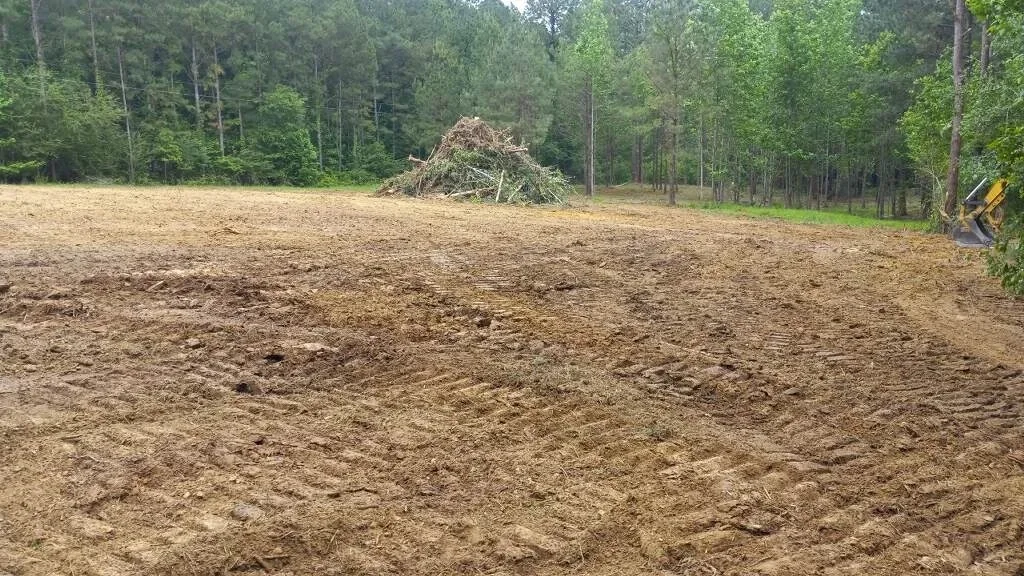
It helps to understand why the spread is so wide within one county. A gentle lot in Leicester with a few saplings and scattered pulpwood might genuinely land near the bottom of the range. The equipment can move freely, the stumps are small, and the material can be chipped and spread on site rather than hauled. Move that same acre to a steep Weaverville hillside with mature hardwoods, and everything changes. The track hoe has to work slower, the operator cannot reach as much ground from one position, and the cut-and-fill volume for a usable pad might triple. Hauling stumps off a steep lot means loading them downhill onto a truck that may not be able to get close. Each of those steps adds cost that a flatland per-acre figure never accounts for.
Access is the quiet variable that surprises people. A lot with a paved driveway already cut to the building site is a different job than a lot where the contractor has to improve a temporary access road just to get equipment in. On some Buncombe tracts, the access work alone can rival the clearing cost. If a bidder has not asked about access, they have not priced your job.
The money is in the dirt, not the trees
On flat Piedmont ground, clearing is mostly a timber and hauling equation. On a Buncombe hillside, the expensive part comes after the trees are down. A cut pad for a home means moving material from the uphill side to the downhill side, and that material has to be compacted and stabilized or it will not hold a foundation. The yardage you move is the number to watch.
Three things move it most:
- Slope. A 15 percent grade and a 30 percent grade are two different jobs. Steeper ground means more cut, more fill, and more retaining and drainage work.
- Stumps. Leaving them is cheaper up front and costly later if they rot out under a driveway or a pad. Hauling them off-site costs more than burning where burning is allowed.
- Erosion control. Silt fence, check dams, and stabilization seeding are not optional on disturbed ground near a waterway, and the county and state expect a plan for them.
If your project also involves reshaping the lot after clearing, our guide to grading costs walks through how pad prep, cut-and-fill, and final grade are priced separately from the clearing line.
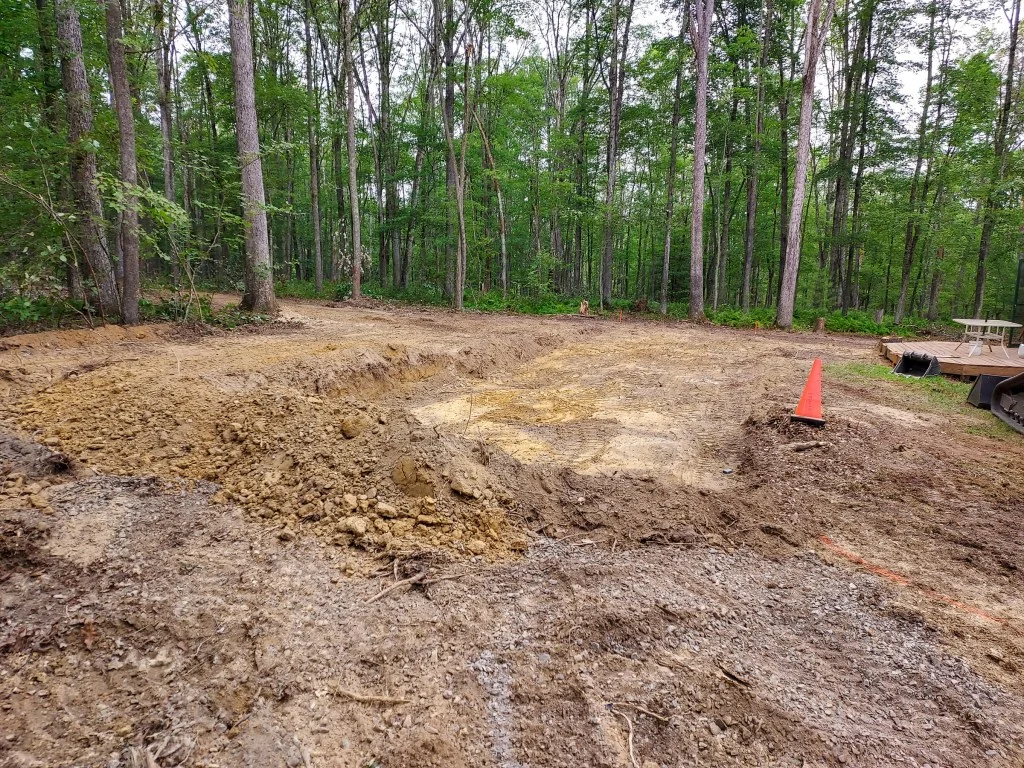
Consider what a cut-and-fill pad really involves on a Weaverville hillside. The contractor removes trees and stumps, then begins cutting into the uphill slope and pushing that material downhill to build up the pad. The fill has to be placed in lifts and compacted, or it will settle unevenly and crack a foundation. On a steep lot, the fill depth at the downhill edge can be substantial, which means the compaction work and the risk both rise. That is dirt work, not tree work, and it is where a large share of the budget goes.
Drainage is the other half of the dirt equation. Water that comes off the cut slope above the pad has to be intercepted and carried around the building envelope, not through it. That means a cut-off ditch or swale at the top of the cut, a stable outlet, and often a culvert under the driveway. On lots near a stream or in a buffer, the outlet has to be designed so it does not dump sediment into the waterway. None of this is visible in a per-acre clearing rate, but all of it shows up in the final invoice. The honest way to bid it is to separate the tree removal from the dirt and drainage, which is what the line items above are meant to do.
Rules, permits, and who can legally do the work
North Carolina regulates land disturbance, and the thresholds matter. Larger disturbed areas and work near streams and buffers typically require an erosion and sedimentation control plan and, in many cases, a permit before the first tree comes down. The relevant code and engineering standards sit with the NC Department of Insurance and Building Code Council, and storm-water and water-quality expectations trace back to the U.S. Environmental Protection Agency. On mountain ground, silt fence and stabilization are standard requirements, not extras.
On the contracting side, the NC Licensing Board for General Contractors sets the threshold at which a job must be handled by a licensed general contractor. Clearing and grading contractors should be able to tell you how that applies to your scope and whether the work needs a permit. Anyone who shrugs off erosion control or the permit question is telling you how the rest of the job will go.
Clearing is also only the front end. If you are planning a build, the sequence usually runs clear, then grade, then excavate footings and utilities — the whole arc is what our grading and excavation overview covers.
There is a practical side to the permit question that catches homeowners off guard. A small clearing job that disturbs less than the state threshold may not need a plan, but the moment the scope includes a driveway crossing a drainage way, a pad near a stream buffer, or a disturbed area above a certain size, the paperwork changes. The county and state do not always send someone out to a small job, but if a neighbor complains about muddy runoff or the work is visible from a road, the inspection can happen after the fact. At that point, the cost of stopping work and installing controls under pressure is far higher than doing it up front.
It also matters who pulls the permit. Some clearing and grading contractors hold the right credentials to file an erosion and sedimentation plan; others do not. If your job needs a plan and your contractor cannot produce one, you may end up hiring an engineer separately, which adds cost and time. Ask early whether the bidder handles the erosion control plan or expects you to. The answer tells you whether the quoted number is the real number.
How to keep a clearing bid honest
Four habits separate a fair quote from a head fake:
- Price the acre, then price the extras. Get a per-acre number and a separate line for stump removal, hauling, and drainage. Bundled lump sums hide the part that grows.
- Walk the lot with the bidder. The slope and the drainage outlet are visible. If nobody looks at where the water will go, the number is fiction.
- Ask about disposal. Burn, chip, haul, or sell. Each one has a real cost, and you should know which one you are paying for.
- Check against the table above. A bid far outside the bands deserves an explanation, especially on steep ground where rock and haul distance can genuinely justify it.
If your project is a full site prep rather than just trees, start with the land clearing service page to see how the scope is broken out, then come back here for the pricing.
One more habit worth building: ask what happens if the job uncovers something unexpected. On Buncombe ground, that could be a rock ledge that stops the stump grinder, a spring that surfaces when the canopy is gone, or an old dump site buried under leaf litter. A bidder who has worked this county knows those possibilities and will tell you how they handle changes. A bidder who quotes a firm number and promises no surprises is either guessing or planning to negotiate later. Either way, you want to know which before the equipment shows up.
Finally, get the disposal plan in writing. Burning is common in rural parts of the county but not always allowed, and burn bans happen. Chipping and spreading is clean but leaves material on site that can affect grading. Hauling is the most predictable but the most expensive. The right answer depends on your lot and your timeline, but you should be the one choosing it, not discovering it after the fact. A clear disposal line item is one of the simplest signs that a bid was put together by someone who has actually cleared ground here.