In Montreat, every driveway is a drainage decision
Montreat sits in a cove off the Black Mountain side of Buncombe County, and its residential roads climb into a hardwood bowl where stormwater has been running downhill since long before anyone paved. A driveway here is not a flat ribbon of stone; it is a controlled channel. When the town gets the kind of rain the National Weather Service regularly flags across the southern Appalachians, water arrives fast, moves downhill hard, and looks for the easiest path. Your driveway either becomes that path or it isn't built correctly.
So the first question isn't how many tons of gravel. It's where the water comes from, where it currently goes, and where the grade has to send it next. Upstream neighbors, the road crown, and oak-leaf-clogged culverts direct thousands of gallons per storm at your apron. If the answer isn't daylight or a properly sized pipe, no amount of new stone holds.
What makes Montreat different from a Black Mountain subdivision off Route 9 is the combination of narrow platted lots and mature canopy. The original cottages and conference-era homes were sited for shade and views, not for equipment access. A modern gravel drive often has to preserve a 100-foot hemlock or a heritage oak, and that decision forces the alignment. Routing around a tree usually means a tighter switchback, which means higher velocity water at each curve. That is why the crowning, the fabric, and the turnout placement all have to be designed together, not ordered off a truck list.
The second local reality is the leaf drop. Montreat is a hardwood cove, and from late October through December the canopy sheds enough material to mat a culvert inlet in a single week. A pipe that works in July can be blind by Thanksgiving if the inlet isn't armored and the outfall isn't clear. Any honest driveway scope on this side of Buncombe County has to answer that seasonal problem, not just the installation day.
Reading the lot before quoting the job
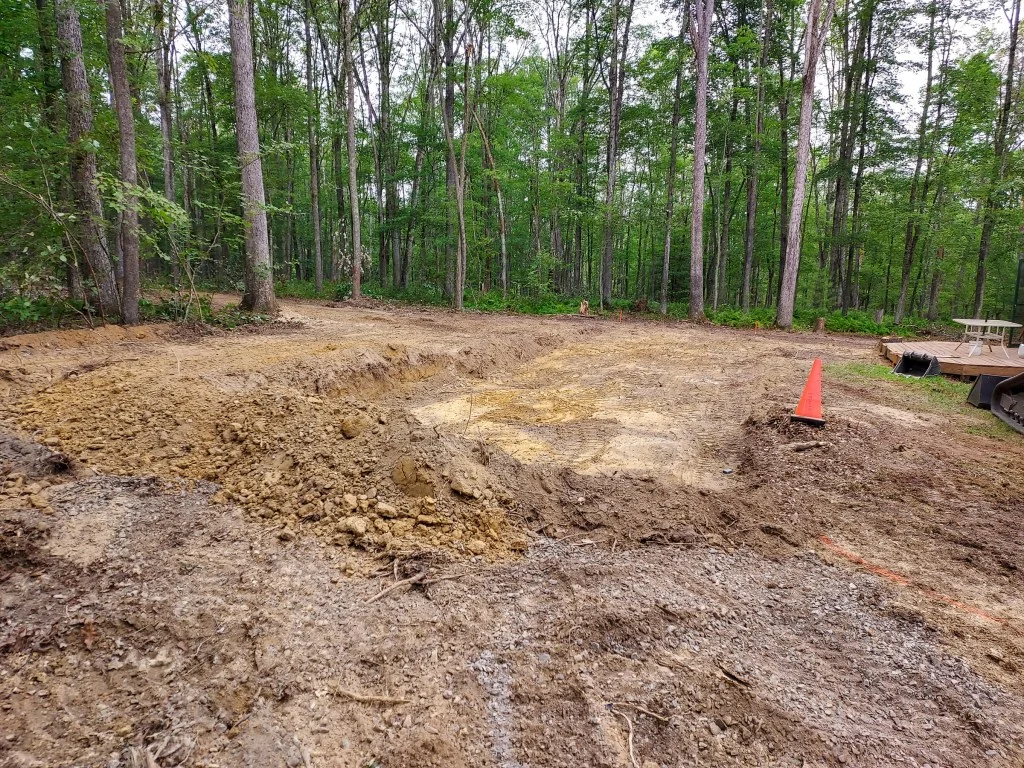
Montreat lots tend to be narrow, wooded, and pitched. A driveway often has to thread between trunks, cut into a bank on one side, and place the uphill cut at a grade steep enough that the gravel itself wants to slide. Crews that do this work seriously read three things before pricing: the vertical drop from road to build site, the culvert diameter that drop demands, and whether the uphill cut exposes clay or rock. Clay means import stone and drainage fabric; rock means a breaker and a different day rate.
On many of these lots the vertical drop from the town road to the house pad runs 20 to 60 feet over a run of 100 to 250 feet. That is a grade range where rounded stone migrates downhill after a few hard storms and where water leaving the pipe at the bottom of the drive carries velocity. The honest fix is usually a series of grade breaks rather than one continuous slope, with turnout at each break pushing water off the drive before it accumulates.
The tool for turning that read into a real number is a proper site assessment — a grade walk, a slope estimate, and a sketch. The Montreat grading contractor page covers what a legitimate first visit looks like here so you're comparing apples to apples. A quote built without that walk is a guess, and on a slope this specific, a guess is how people end up paying twice.
What gravel driveway installation costs on Buncombe County grades
Ranges below assume a single-family drive of roughly 150-400 feet on a moderate-to-steep Montreat lot. Steep pitches, long runs, and heavy clearing push toward the high end. These are working regional bands, not quotes; the plan for your actual grade is the only thing that produces a real number. Full line-item ranges for the county are on the Buncombe County grading cost page.
| Scope | Typical range |
|---|---|
| Short, mild-grade drive (under 150 ft), existing base usable | $3,200-$5,000 |
| Moderate steep drive with grading, fabric, and new gravel base | $5,500-$8,500 |
| Steep cut-in with culvert, retaining edge, and drainage outfall | $8,000-$9,800+ |
| Culvert and turnout work added to existing drive | $900-$2,800 |
| Crown, re-grade, and top-dress refresh of existing gravel | $1,200-$3,400 |
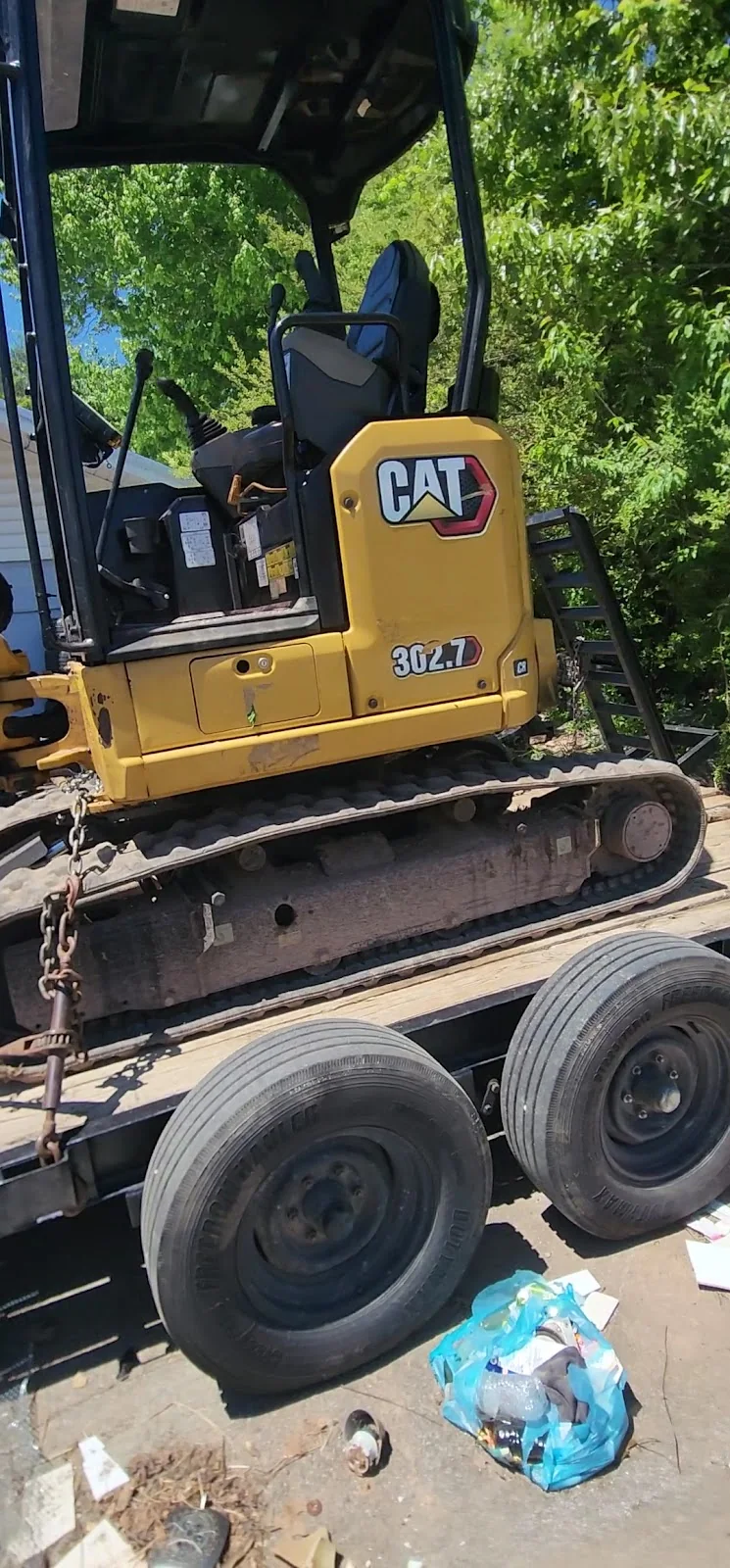
Two cost drivers specific to this cove are worth calling out. First, access: if a loaded tri-axle cannot reach the build site, material has to be shuttled with a smaller machine, and that labor shows up in the number. Second, clearing: mature hardwood on a tight lot means felling, bucking, and hauling, often while protecting a root zone the owner wants kept. Neither of those is padding. They are the difference between a price and a fantasy.
The parts of the build that decide whether it survives
Four details separate a Montreat driveway that lasts from one that washes out in two seasons. First, the crown: a slight center high so sheet flow moves off the sides instead of down the channel. Second, fabric: separation fabric under new gravel on clay cuts prevents the stone from sinking into the subgrade. Third, the culvert: sized for the watershed above it, not for the pipe the last owner had. Fourth, the outfall: water must land on stable ground, not on your neighbor's slope. The NC Department of Insurance engineering division and the state's adopted ICC-based building code treat site drainage as a real structural concern, not decoration.
The watershed math on a Montreat lot is not academic. A quarter-acre of uphill woods, driveway, and roof above your culvert inlet can shed a surprising volume in a short cloudburst, and the pipe that looked generous in dry weather becomes the bottleneck. That is why the sizing has to account for the slope above you, not just the width of the drive. The same logic applies at the outfall: if water discharges onto exposed clay instead of riprap or stone, it will cut a gully back toward the pipe and undermine the whole structure within a few seasons.
Where a drive crosses a stream buffer or a mapped drainage, federal rules on wetland and waterway impacts can come into play, and the EPA publishes the general framework that local permitting follows. That is a step to confirm before equipment shows up, not after.
This is where the driveway grading and gravel page earns its keep: a drive installed with attention to those four items is cheaper over ten years than one installed twice.
Hiring a crew for a grade this specific
Mountain-slope driveways are their own discipline, and the licensure line matters once a job crosses the state threshold — check the NC Licensing Board for General Contractors before signing. Three local questions to ask every bidder: Have you built on a grade like mine — not a flat lot in Black Mountain, this slope. Who sizes the culvert, and can they show me the sizing math. And what happens to the water when it leaves my pipe. If the answer to the third question is a shrug, walk.
A fourth question is worth adding in this part of Buncombe County: how will the inlet be protected from leaf drop, and who maintains it. On a wooded Montreat lot, a simple armored inlet with a debris cage or a rock apron is often the difference between a pipe that drains for years and one that dams up the first fall. A contractor who has worked this cove will have an answer ready.
Do not accept a quote built solely from a satellite photo. Montreat's canopy hides grade. Someone has to walk it.
Storm history on this county, and why it matters to a driveway
Federal disaster records for this county list 19 declared events across 1973-2026, largely storm, flood, and landslide family. That record is the argument for building the drainage first. Every one of those events tested driveways on these slopes, and the ones that survived had a plan for where the water went. Your driveway is either part of that plan or a casualty of it.
The practical takeaway for a Montreat homeowner is not to wait for a washout to think about grade. If a drive is already showing ruts along the center, stone migrating toward the road, or a pipe that backs up in a hard rain, those are the signals that the drainage plan, if there ever was one, has stopped working. Rebuilding the crown and re-sizing the culvert is usually far less expensive than rebuilding the base after a failure, and it is the work that actually matches the terrain here.