The one-acre line that decides whether your Mars Hill driveway job needs a state permit
Most Mars Hill driveways climb or cut. That fact does more to set repair scope than anything else about the property. A homeowner on a gentle bench off a valley road may be looking at a regrade and a load of stone; a neighbor a quarter-mile up a hollow faces a washout that has been digging itself deeper every spring.
The dividing line is less about the driveway than the acreage and slope above it. Under North Carolina's erosion and sedimentation rules, land-disturbing activity on a project that disturbs an acre or more triggers a state permit and an approved erosion control plan. For a driveway, that usually arrives attached to a larger build. For a mom-and-pop regrade on a half-acre lot, the work is typically the county's business, not the state's. Knowing which side of the line you sit on before you call anyone is worth money, because it changes who signs off and what a contractor must carry in the bid.
What that adds when it does apply: a plan drawn for your slope, silt fence and a stabilized construction entrance, inspection points before the stone goes down, and a paper trail that outlives the job. It is not busywork on a 20% grade. That is the version of Mars Hill that eats driveways.
What mountain ground does to a driveway here
Mars Hill sits in Madison County, just up the road from the county seat in Marshall, and its residential ground is a good sample of the whole county: valley-floor lots along the creeks, steep hollows where a driveway is a cut-and-fill operation by necessity, and old farm lanes that were never graded so much as worn in by trucks.
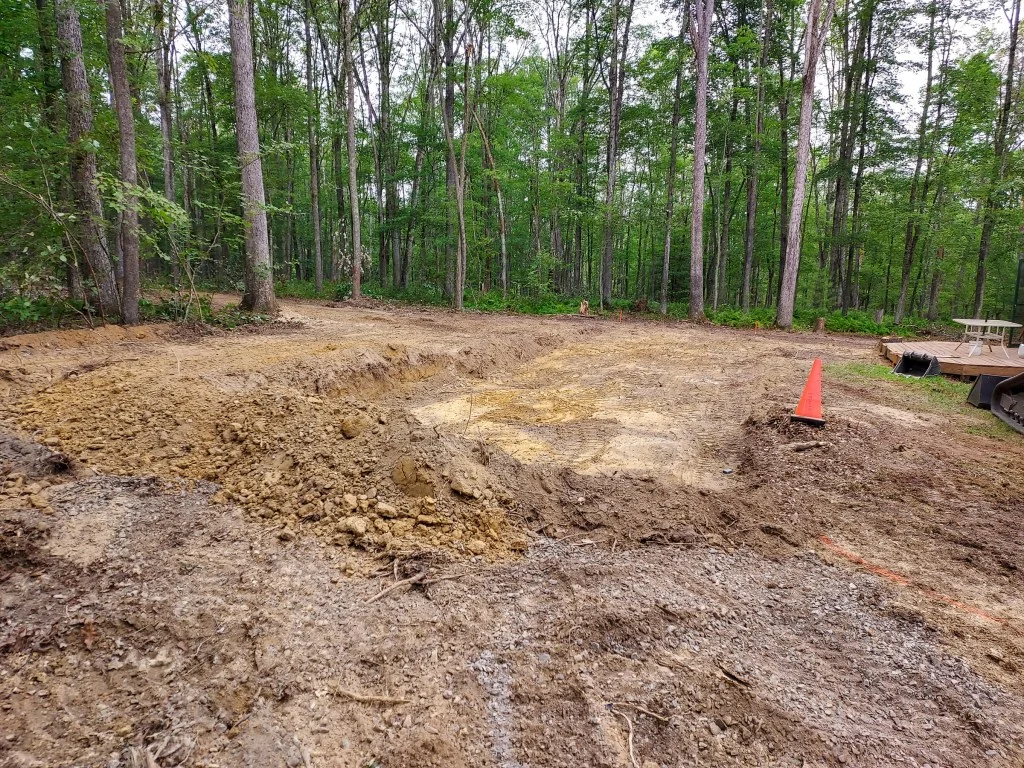
The failure patterns follow the terrain. A steep drive that was crowned once and never again sheds water down the middle and ruts into a chute. Water crosses the road because the culvert below it is undersized or crushed and nobody checks it until a storm moves half the driveway into the ditch. On the honest flat ground, the enemy is the opposite: ponding where the fill settles, and stone that disappears into the mud a load at a time.
National Weather Service records for these mountains help explain the pattern — NWS has logged the recurring heavy-rain and flash-flood episodes that make mountain driveways a maintenance-watch item rather than a set-and-forget one. If you want the long view, 21 federal disaster declarations touch this county across 1978-2026, overwhelmingly storm and flood events. On hillside lots, that history is the reason a washout repair and a regrade are not the same job.
The Mars Hill price picture, by scope
Prices here sit inside the same band the rest of the region uses — see the full Madison County grading cost breakdown for how the county's ground moves the numbers. The short version is a scope table, not a single number, because a driveway that drains fine and a driveway that now routes water into a foundation are different projects.
| Scope | Typical range | When it's the right call |
|---|---|---|
| Regrade existing gravel | $350 – $1,200 | Crown is gone, ruts and potholes, stone still present |
| Washout repair with fresh stone | $400 – $1,500 | A section washed out; rebuilding the base and re-stoning it |
| Ditching and culvert | $800 – $2,800 | Water crosses or runs beside the drive and has nowhere to go |
| Engineered drainage on steep grade | $2,500 – $6,500 | Drive over ~15% grade, recurring washouts, water from uphill |
Two things push Mars Hill jobs upward without adding a single loader hour: haul distance on a narrow road, and the uphill neighbor's runoff, which is nobody's fault and everybody's problem once it lands on your drive. That is also why engineered drainage quotes get compared against ditching and culvert quotes — on a steep lot, the cheaper scope can be the one that fails first. If the drive has repeated washouts, the fix usually lives uphill of where the damage shows. The full driveway grading and gravel guide walks through the sequence.
Fixing the water question before the gravel question
The order matters, and it is the fastest way to spot a bid that will not hold: does the plan address where water comes from and where it leaves, or does it just spread stone and grade a crown? Stone laid on a road that still collects water is a yearly expense disguised as a repair.
On the ground, that means checking the culvert for size and health, cutting the ditch deep enough to actually carry flow, armoring the outlet so it does not dig a crater below the pipe, and giving the uphill side a place to shed. The International Code Council treats site drainage and grading as core requirements for exactly this reason — water managed at the road edge is water not working on the structure. For any job where runoff threatens a house or outbuilding, that conversation belongs before the repair, not after.
Hiring on a mountain road
Three questions separate the crews that fix Mars Hill drives from the ones that re-gravel them every year. First: has the crew worked your kind of grade — narrow switchbacks, soft shoulders, limited turnaround — or have they only graded flat lots? Second: for any scope beyond a regrade, does the bid state where water goes after the job? Third: if the project disturbs an acre or more, who files the erosion plan, because that is a licensing question before anything else. North Carolina sets the threshold and the rules through the NC Licensing Board for General Contractors, and a bid that is vague about it will be vague about everything else. When the work is done, a Mars Hill grading contractor who knows the local ground will tell you what to watch for next spring, not just what it costs now.