What the ground under Barnardsville does to an excavation bid
Barnardsville sits up the North Fork valley in Buncombe County, and the ground here is not the ground an Asheville contractor prices. Three things show up on nearly every lot: sticky red clay that holds moisture and won't compact when it's wet, shallow rock shelves that turn a smooth footing dig into a hammering job, and old fill pushed onto hillside benches decades ago by whoever built the first house on the parcel. Each one changes the machine, the day count, and the number on the quote.
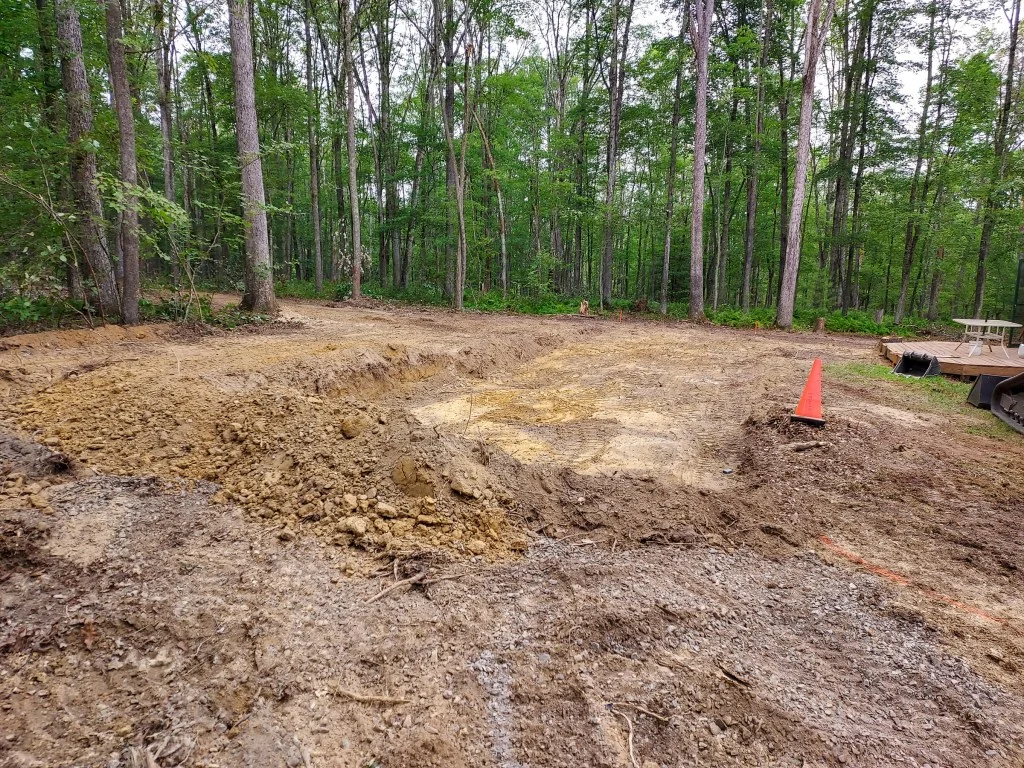
Red clay is the quiet cost driver. Dig it dry and it's manageable; dig it after a wet week and it smears, sticks to the bucket, and refuses to compact without lime or gravel amendment. We see this most in the coves off Dillingham Road and along the lower stretches of the North Fork, where the clay sits deep and the water table stays high well into spring. A track hoe that moves clean dirt all morning can stall out on the same volume of wet red clay in the afternoon, and the operator ends up using the bucket to scrape rather than cut.
Rock is the loud cost driver — when a tooth hits a shelf at two feet, the price moves from dirt rates to rock rates fast. The rock around Barnardsville is often a weathered schist and gneiss that comes apart under a hammer but not under a bucket. That's a real distinction: some days it's a hammer attachment and a few extra hours, other days it's a breaker and a full day billed at rock rates.
And old fill is the unknown: fill that was never compacted to any standard will not carry a footing, so a contractor who is honest will tell you before you pour, not after. On the ridges above the valley, it's common to find a bench that was pushed up by a dozer in the 1970s or 80s with no engineering behind it. That fill will look solid and dry in July and turn into a sponge in February. A test pit before pricing is the difference between a fixed number and a change order.
Scope and what it typically runs in this valley
Barnardsville jobs price off the scope first and the soil second. The table below is the working picture for this side of Buncombe County; the Buncombe County grading cost breakdown carries the same line items at county level.
| Scope | Typical range |
|---|---|
| Footing and foundation dig, single-family | $3,500-$7,500 |
| Basement or walkout dig with haul-off | $8,000-$18,000 |
| Driveway cut and gravel base, 300-600 ft | $4,500-$12,000 |
| Utility trenching (water, septic, power) | $1,200-$4,500 |
| Septic system excavation and install | $6,000-$15,000 |
| Pond, culvert, or drainage channel work | $3,000-$10,000 |
| Rock removal, per day of hammering | $1,500-$3,500 |
Two honest notes. First, a bid without a rock clause is a bid that will grow — rock in this valley is common enough that a competent contractor carries a line for it. Second, haul-off dirt has a real cost, and on these steep driveways the trucking sometimes costs more than the digging. Ask where the spoil goes before you sign.
The scope details matter more here than in flatter parts of the county. A 600-foot driveway cut on a 15 to 20 percent slope along the North Fork isn't just more dirt; it's more switchback, more culvert, and more gravel to hold the grade. A walkout basement on a hillside bench means the uphill cut wall has to be benched and drained, and the downhill side needs a retaining approach that won't push over the first wet spring. These are the line items that separate a Barnardsville bid from one priced off a flat lot in Weaverville.
Water is the other quiet line. Any cut that intercepts a seep or a spring up the slope turns into a drainage job — a French drain, a swale, or a culvert under the drive — and that work is real money even when it's not much dirt. On the creekside lots near the lower valley, a septic field has to be sited above the flood plain and away from the creek, which sometimes pushes the drain field uphill into rock. That combination is one of the more expensive site-work puzzles this valley produces.
Storm water is not a side issue up here
The federal disaster record for Buncombe County lists 19 declared events across 1973-2026, and the storm and flood family dominates that list. That history is not abstract on the North Fork — creeks rise, hillsides move, and driveways that were fine for a decade wash out in an afternoon. Excavation work here has to plan for water that arrives fast, and the National Weather Service flood outlook for this part of the mountains is part of reading the site honestly.
In practice that means: cut driveways with a cross-slope and a ditch, not a flat pad; set culverts sized above the historical flow, not at it; and put drainage around the foundation before the foundation, not after. Grading that ignores the uphill neighbor's runoff is a problem the next storm delivers.
The mountain shape of the valley makes this worse than the raw rainfall numbers suggest. A storm that drops an inch in Asheville can drop two or three on the ridge above Barnardsville, and all of that water has to go somewhere. The places that fail are the ones where the cut slope sheds directly onto a driveway or a foundation wall with no interception above it. A modest swale at the top of the cut, cut before the foundation is dug, handles the same water that otherwise becomes a repair bill.
It's also worth being honest about timing. Grading work in this valley is best done in late spring through early fall, when the clay has a chance to dry between rains. Scheduling a footing dig for a week that turns wet is the single most common way a Barnardsville excavation budget gets blown, and it isn't the contractor's fault — the ground simply won't hold a grade when it's saturated.
Permits, septic, and the rules that apply here
Buncombe County and the state regulate most of what an excavator touches on a residential job, and the rules tighten as the scope grows. For anything beyond routine site work, the NC Licensing Board for General Contractors sets the threshold at which a licensed general contractor must be on the job, and septic work runs through county environmental health before any machine moves. The NC Office of State Fire Marshal carries the code-enforcement side, including the erosion-control and setback rules that catch people by surprise on creek-front lots. On the North Fork, creek setbacks and slope-disturbance limits are worth checking before the first cut, not after.
If the project touches a stream or wetland, the U.S. Environmental Protection Agency rules under the Clean Water Act come into play, and a permit that wasn't pulled is a much more expensive problem than one that was. A good Barnardsville excavator will tell you which permits the job needs and who pulls them.
Sediment control is the permit item people underestimate. Any land disturbance beyond the small-job threshold needs a plan for keeping dirt out of the creek, and on these slopes that means silt fence, a stabilized construction entrance, and often a sediment basin before the first bucket of dirt moves. The county and state both inspect, and a failed inspection stops the job. Building the erosion control into the bid from the start is cheaper than retrofitting it after a complaint.
Septic is the other gate. In this valley, a lot that looks buildable from the road may not pass a perk test in the spot you want the house, and the approved drain field location sometimes drives the whole site plan. It's worth getting the septic approval pinned down before finalizing the footing layout, because moving a drain field after the foundation is staked is an expensive kind of rework.
Picking a crew for this kind of ground
The crews that do well in Barnardsville are the ones who have dug here before — who know that red clay needs the right moisture, that the rock shelves are shallow in some coves and absent in others, and that a driveway cut on a 20 percent slope is a different job than the same length on flat ground. Ask what they carry for rock, ask where the spoil goes, and ask how they handle water during the dig. When you're comparing bids, the excavation contractor guide covers the questions worth asking, and the Barnardsville grading page covers the finish-work side of the same site.
Two practical things to listen for. A contractor who walks the lot and probes the ground before quoting is doing the work that separates a real number from a guess. And a contractor who tells you plainly where their bid could grow — rock, wet clay, unexpected fill — is more trustworthy than one who quotes a flat price and stays quiet about the unknowns. In this valley, the honest bid usually lands closer to the final invoice than the low bid does.