The one-acre line that decides your Flat Rock dig
Flat Rock's terrain did not get flat by accident. The village sits on old piedmont ground at the edge of the Blue Ridge escarpment, where building pads have been cut into slope since the first summer estates went up. That history matters practically: when you add a foundation, a driveway cut, and a grading pass together, small residential jobs in this county can cross one acre of disturbed ground faster than most homeowners expect.
Cross that line and North Carolina's erosion and sedimentation rules apply before excavation starts. A state-issued erosion control plan, a permitted entrance, and inspection hold points get added to the schedule. The common Flat Rock split: a single-home lot with a tight footprint and no big driveway cut stays under the threshold; a new build on a graded ridge pad with a long access road, or any project that clears more slope than the footprint needs, usually does not. If your excavator cannot tell you which side of the line you are on, get a second opinion before mobilizing equipment.
Consider a concrete example that plays out on the ridges off Greenville Highway and up toward the Carl Sandburg home side of the village. A 2,400-square-foot house with a full basement and a walkout on the downhill side disturbs roughly 3,000 to 4,000 square feet just for the footprint and the excavation envelope. Add a 120-foot driveway cut that is 14 feet wide and you tack on another 1,700 square feet, plus another 1,500 to 2,000 for the slope that has to be re-graded so the driveway is not a cliff. Suddenly you are at 7,000 square feet before anyone has staged a single load of gravel or a spoil pile. The one-acre line is 43,560 square feet, so a single house with a long cut still usually stays under. Where Flat Rock jobs tip over is when the lot is being improved beyond one house: a detached garage or workshop, a pool pad, a barn, a second building envelope, or a shared access drive serving a neighboring parcel. Any two of those in the same permit season and the disturbed area is close enough to the threshold that the county will want a plan on file.
The sequencing consequence is real. Once the project needs an erosion control plan, you cannot simply dig when the weather is dry and the excavator is free. The plan has to be prepared, submitted, and reviewed, and the ground-disturbing work cannot start until there is an approved plan and, depending on the scope, an on-site pre-construction meeting. Ground cover, silt fence, and stabilized construction entrances generally have to be installed before excavation begins, not after. For a homeowner who was told by a contractor "we'll just get started next week," that is a two- to four-week schedule shift in the middle of the best digging season.
What footing and foundation excavation costs here
Henderson County pricing tracks the county cost table for grading work, and excavation line items sit inside the same structure. Depth, spoils removal, and access are the three movers — rocky Flat Rock ground can also add hammer time that a soft-lot quote never includes.
| Scope | Typical range |
|---|---|
| Footing trenches only — shallow, open access | $1,200 – $4,500 |
| Crawl-space or basement dig, moderate depth, machine access | $3,500 – $9,500 |
| Full foundation excavation with spoils haul-off and slope work | $9,500 – $18,000 |
| Engineered fill placement and compaction (priced per spec) | Quoted with the excavation scope |
Any Flat Rock bid that lands outside these bands usually reflects either a very small footing-only job or a structural repair scenario the excavator is folding into the dig. See the foundation excavation scope guide for what a line-item bid should contain.
To see how those bands actually get built, think in line items. A Flat Rock footing-only job on a flat lot with a short gravel drive typically quotes as: excavator mobilization (half day), trenching the perimeter to frost depth, a small spoils pile on site, no haul-off, and backfill with the same spoils after the concrete sets. That combination is what lands in the $1,200 to $4,500 band. A crawl-space or basement dig on a moderate side slope usually adds a second machine for hauling, a bigger spoil footprint or an off-site disposal line item, and a drainage detail at the low corner. That is the middle band. The top of the range is where Flat Rock projects separate from county-average pricing: uphill cut, downhill fill, engineered pad, spoils that cannot stay on site, and a rock clause that actually triggers. If a bid you receive is a single lump number with no line items, it is not really a bid — it is an estimate dressed up as one, and you will not be able to compare it to the next contractor's number.
Two line items that Flat Rock homeowners should specifically ask about, because they are the ones quietly missing from cheap quotes: spoils destination and stabilization. Spoils is the excavated dirt. On a lot with room, spoils can stay on site in a graded pile, which is cheap. On a tight lot with no place to put mounds of red clay, spoils get trucked off site, and the trucking cost is a per-load charge that varies with distance to the receiving site. Stabilization is the grass, matting, or stone that has to go back on any disturbed ground once the excavation is done. Under the state erosion rules, exposed disturbed soil cannot simply sit uncovered through the winter, and stabilizing it correctly is a real cost. Bids that omit both of those line items are not honest bids, they are teasers.
Depth, water, and what the inspector will ask
Footings here are set below the frost line and on undisturbed or engineered soil, and the county inspector will want to see the bearing surface before concrete. In Flat Rock the wrinkle is groundwater: hillside lots shed water toward the low corner, and a dug footing trench that fills overnight is a real problem, not a hypothetical. The International Code Council model codes that North Carolina adopts treat foundation drainage as a structural requirement, and the practical translation is simple — excavation, drainage, and backfill get planned together or the dig gets redone.
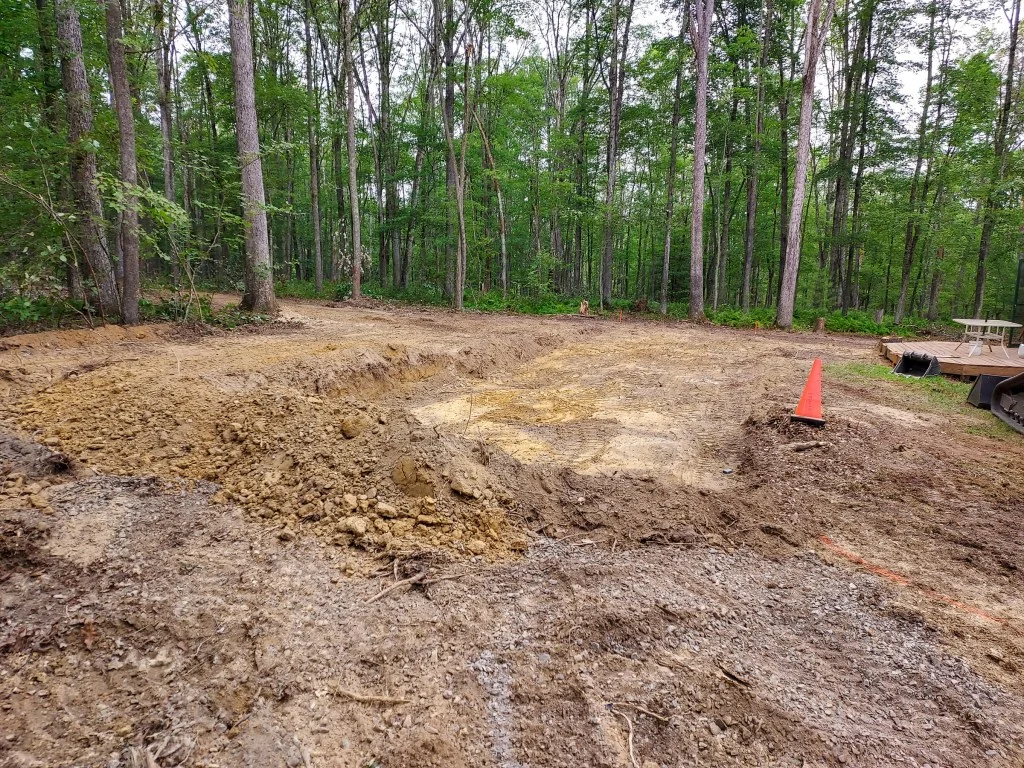
The other wrinkle is rock. Flat Rock's name is earned: shallow bedrock shows up on plenty of lots, and a machine hour quoted for dirt becomes a hammer hour quoted for stone. A responsible excavator probes before quoting a per-hour figure, and a fixed price that ignores rock at depth is a change order waiting to happen. In this part of Henderson County, the rock is not a uniform layer. It comes in lenses and seams, and a lot can be soft on one corner and refusing the bucket twenty feet away. That is why an experienced local bidder will either probe with a small machine before quoting or write a clear rock clause into the bid: how rock is detected, how it is priced once detected, and whether the homeowner approves hammer time before it starts. The worst version is an hourly number with no rock language at all, because then every hour of hammer time is a surprise.
The inspector's questions are predictable, and the right time to answer them is before the excavator arrives, not after the trenches are open. The building inspector will look at three things relating to the foundation: the depth relative to frost, the bearing soil condition where the footing will sit, and drainage. Footings cannot sit on loose fill or on organic material. If the lot has been previously graded and there is a question about whether the soil under the footing is undisturbed or engineered, the inspector may ask for the geotechnical or engineering documentation. Setting footings on the wrong material either fails inspection or, worse, passes inspection and settles two years later. The inspection itself is scheduled by the contractor, and in Henderson County it typically takes a day or two of notice, which can matter if concrete is booked and a truck is coming.
Licensing, safety, and who should be on the job
Excavation ties into more regulated work than most homeowners realize. The North Carolina Licensing Board for General Contractors sets the dollar threshold at which a project needs a licensed general contractor, and foundation and footing work routinely crosses it. Separately, any trench a person enters is covered by OSHA's excavation safety rules — protective systems, spoil placement away from the edge, and no unsupported vertical walls over the limit. Those rules exist because cave-ins kill, and they are a fair question to ask any crew on your lot.
On slope lots near the escarpment, it is also worth asking whether the design includes an engineered retaining or shoring element. That is a different trade from digging, and the best excavators say so rather than improvising it. If your project needs grading beyond the dig itself, the Henderson County grading cost breakdown is the right companion page.
The insurance question is closely related and gets asked less often than it should. An excavation contractor working on your lot should carry general liability insurance and, if the crew enters trenches, workers' compensation coverage on its own employees. Homeowners who hire an uninsured crew and then have a machine roll into a neighbor's fence, or a worker get hurt in a trench collapse, can find the claim landing on their own homeowner's policy. Asking for a certificate of insurance before mobilizing is not suspicious, it is ordinary. The same basic rule applies to any subcontractor the excavator brings — the certificate should cover the actual entity doing the work, not a related company.
Finally, the boundary question. Flat Rock lots often have irregular property lines that follow old fence rows or septic field boundaries, and a footing trench dug six inches past a line is a real neighbor dispute. A current survey is worth having on hand before the excavator starts, especially on any lot where the previous owner did not build or where the lot was subdivided within the last decade. Digging to the survey line and no further is the standard the excavator should be held to.
Why local crews bill differently than out-of-county ones
Flat Rock is small, and the closest heavy equipment is often already booked on other jobs in the county. A crew that has to haul a machine from outside Henderson County builds that travel into the quote, and a crew that knows the ground from prior work does not guess at rock. That knowledge shows up in the bid in one of two ways: a fair fixed price with a defined rock clause, or an hourly number with an honest warning that the total is unknown.
The local Flat Rock grading contractor list is the place to start if you want to compare bids side by side, and it helps to hand every bidder the same scope sheet so the numbers are actually comparable. One more Henderson County note: because the county sits in a storm-and-flood-prone part of the state, 16 federal disaster declarations have touched this area across 1978-2026. Each one rewrote how local builders think about site drainage, and a foundation excavation plan here that ignores where the water goes uphill is not finished.
There is a second scheduling reality that local crews understand and out-of-county crews often do not: Henderson County's building season runs on the same rhythm as the terrain. Foundation work in the upper Flat Rock hollows gets squeezed between the soggy late-winter ground and the summer afternoon storms that pop up over the Blue Ridge. A crew that lives here knows to schedule footing digs early in the day so the trench is closed before a thunderstorm dumps an inch of rain into an open hole. A crew that hauls in from across the county line may not build that pattern into its scheduling, and the homeowner pays for it in a re-do. If a bid you receive has a mobilization fee that seems larger than another's, the honest question is not whether the fee is too high but where the machine is coming from and what the travel adds in time.