The order a Leicester drainage job actually runs in
A crew that starts by digging is guessing. The first half-day here is spent watching water. On a Leicester hillside, rain arrives from above, not from your roof alone, so the useful question is where the uphill acreage sheds into your lot before anything gets cut. That walk usually happens alongside the homeowner, because you know which corner of the yard goes soft first.
Step two is testing, not buying pipe. Someone pours water at the suspect low spot or runs a hose into the footing drain and watches how long it takes to reappear downhill. A yard that drains in an hour needs a different answer than one that stays wet for three days.
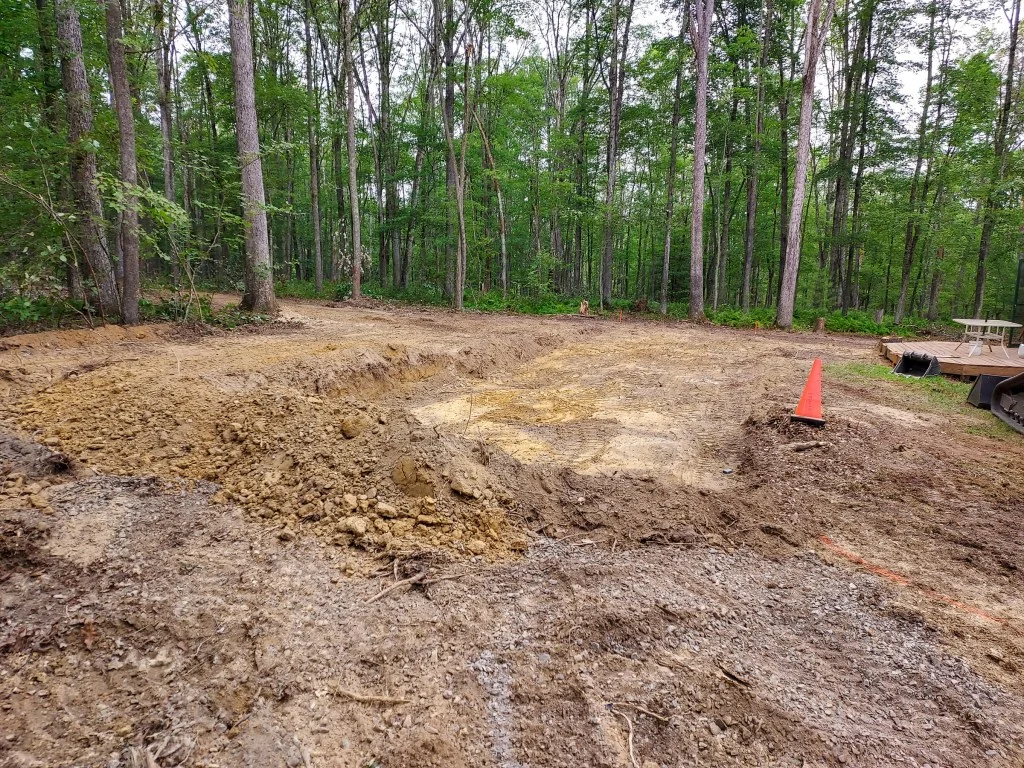
Step three is the decision point: grade it, pipe it, or both. Step four is excavation and pipe-laying, which is the loud day. Step five is backfill, compaction along the trench, and seed or sod. A single French drain serving one foundation wall is usually a one- or two-day job. Whole-yard work with a swale, a dry creek bed, and two downspout runs typically takes three to five days, with weather the main variable because a trench cannot stay open through a heavy rain.
What the work costs in this county
Prices track the Buncombe County grading and drainage cost picture fairly closely. The variable that moves a Leicester bid more than anything else is slope: a lot with a 20-foot fall from back fence to house requires more pipe, more gravel, more labor hours, and usually a retaining element somewhere. Clay ground adds cost too, because it does not absorb, so every gallon must be conveyed rather than allowed to sit.
| Scope | Typical range | Usual duration |
|---|---|---|
| Single-wall French drain, one downspout tie-in | $2,500-$4,500 | 1-2 days |
| Perimeter foundation drain, three sides | $4,500-$9,000 | 2-4 days |
| Yard swale plus grading and reseeding | $3,000-$7,000 | 2-3 days |
| Dry creek bed, decorative rock, moderate run | $3,500-$8,000 | 2-4 days |
| Whole-yard system: drains, swale, downspouts, outfall | $9,000-$14,000 | 3-5 days |
| Drainage plus retaining wall on a steep grade lot | $12,000-$25,000+ | 1-3 weeks |
Anything involving a wall above roughly four feet, or any change to how water leaves the property relative to a neighbor, deserves a real look at the site plan before work starts.
Clay, springs, and what a Leicester yard throws at a crew
The dominant soil across this side of the county is red clay over weathered rock, and it behaves nothing like the sandy loam that drainage advice written for other regions assumes. Water sits on it. French drain stone wrapped in the wrong fabric silts up within a few seasons and quits, which is why filter fabric and gravel gradation matter more here than trench depth.
The second local wrinkle is that Leicester sits on the wet side of the Blue Ridge. The federal record explains why this matters: 19 declared events have touched Buncombe County across 1973-2026, overwhelmingly storm and flood family, and each one tested yards built for drier assumptions. That history is the reason to design for a genuine storm rather than for an average Tuesday. The National Weather Service publishes the local rainfall intensity data worth designing around.
Hillside springs are the third. Where groundwater percolates out of a slope on its own, no amount of surface drainage will solve it, and the honest answer is a sub-surface collection system or a swale that carries the seep past the house rather than fighting it.
Grading, erosion, and staying legal on a slope
Drainage and grading are the same conversation in Buncombe County, because moving dirt changes where water goes. Disturbed ground needs stabilization before the next rain, and that obligation applies to a residential yard the same way it applies to a subdivision. Our drainage and erosion control overview walks through the stabilization sequence a workable job follows.
Two code realities worth knowing before you hire. First, North Carolina treats grading and any associated retaining work under the state building code, and the NC Office of State Fire Marshal administers code enforcement across the state. Second, general contracting work above the state threshold requires a licensed general contractor, and the NC Licensing Board for General Contractors maintains the license lookup and the threshold rules. Ask which side of that line your project falls on before signing.
Also worth a read if your plan includes any regrading near a boundary or a waterway: federal rules on stormwater discharge reach small sites more often than people expect, and the U.S. Environmental Protection Agency publishes the plain-language version.
Choosing and scheduling in a wet season market
Drainage work in this area is seasonal in a way that surprises people. Late winter and spring bring the calls, which means the good crews are booked when your yard is at its worst. The practical move is to get an assessment scheduled during a dry stretch so the crew can see the grade, then let them work the job when conditions allow. If you want to know who is actually working this side of the county, the Leicester grading contractor list is the place to start.
Three questions separate a good bid from a cheap one. Ask where the water goes when it leaves your pipe — an outfall that dumps onto a neighbor's ground just relocates the problem and the phone call. Ask who is responsible if the trench settles and the yard sinks a year later. And ask for the pipe diameter and the slope in writing, because those two numbers determine whether the system still works in five years.