What the crew does, in what order, and how long it takes
A culvert job looks simple from the road and is not. Here is the real sequence on a Buncombe County driveway, and the clock that runs alongside it.
Day zero, before any digging: someone walks the ditch line to find the existing grade, the outlet elevation, and where the water is actually going. On mountain lots the outlet is often the problem, because the pipe has to daylight somewhere below the driveway and the hillside keeps falling away. This walk decides pipe diameter and length, and it is why a phone quote is a guess. On a flat lot in Fletcher or Arden, that walk might take fifteen minutes; on a Weaverville or Black Mountain slope, it can eat an hour just to trace where the water goes when it leaves the pipe.
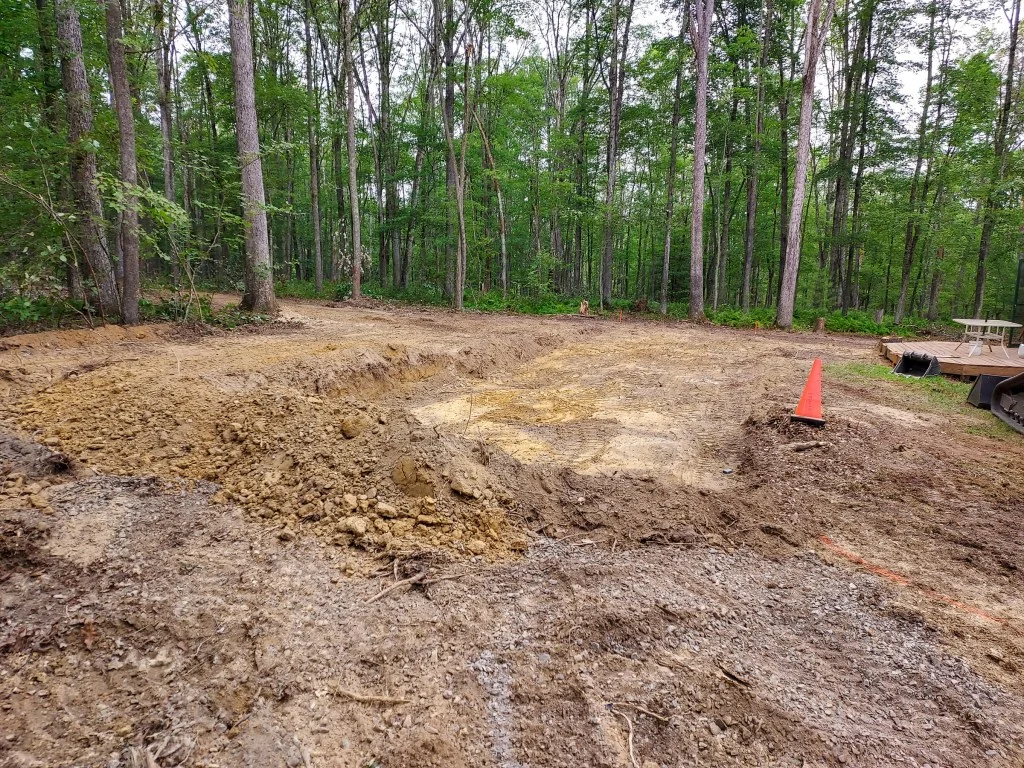
Day one, morning: mark utilities, cut the driveway open, and excavate the trench. A typical residential crossing is twelve to twenty feet of driveway, but the trench itself runs longer because both ends need to daylight at the right slope. Dig time is where terrain shows up: flat Piedmont ground cuts fast, while a cut into a Weaverville hillside with rock and root mass can take most of a day on its own. In Buncombe County, the transition from the French Broad valley floor up into the ridges happens fast, and a single driveway can cross both soil types in fifty feet.
Day one, afternoon: set bedding stone, lay the pipe at grade, and check fall with a level. A pipe laid flat or back-graded holds water, and in this county it will freeze, split, and wash the driveway out above it. This is the step that separates a culvert that lasts twenty years from one that lasts two. The grade check happens with a laser level or a string line and a hand level, and it is the ten minutes that determines everything downstream.
Day two: headwalls or flared end sections, riprap at both outlets, and backfill in lifts with compaction. Backfill is the quiet cost driver. A pipe under loose fill settles, the driveway dips, and the fix is digging it up again. Red clay soil common across Buncombe County compacts differently than the sandy loam you find closer to the river bottoms, and a crew that does not account for that will leave you with a dip after the first wet season.
Day two or three: gravel or asphalt reinstated over the crossing, shoulders dressed, and the ditch graded to feed the inlet instead of bypassing it. That final grading is where a driveway washout problem either gets solved or gets postponed to the next storm. In the Asheville area, that next storm is rarely far off.
Plan on two to three working days for a straightforward residential culvert, and longer when rock, a deep fill, or a waterway permit is involved. Material lead time on larger diameter pipe or precast headwalls can add days before the crew ever arrives. A job in the city of Asheville proper may also need a right-of-way review if the driveway apron meets a municipal street, and that scheduling runs on its own clock.
What the numbers look like by scope
These are working ranges for western North Carolina, not quotes. Pipe material, diameter, length, and how much ground has to be moved are the four variables that move the number most.
| Scope of work | Typical NC range | What drives it |
|---|---|---|
| Short 12-15 inch pipe, shallow crossing | $1,200 - $3,000 | length, dig depth, reusing existing gravel |
| 18-24 inch pipe, typical driveway | $2,500 - $6,000 | diameter, bedding stone, headwall choice |
| Larger or double pipe, deep fill | $5,500 - $12,000 | span, fill depth, riprap volume, traffic control |
| Driveway rebuild over the crossing | add $1,800 - $5,500 | gravel vs asphalt, length of damaged drive |
| Engineered stream crossing | $9,500 - $25,000+ | permits, design, bank stabilization |
If the driveway is being rebuilt anyway, price the two together. Our gravel driveway cost guide covers what a full re-gravel runs and where the culvert fits into that scope.
A few local realities sit on top of those ranges. A crossing on a steep Black Mountain driveway almost always needs more riprap at the outlet than the same pipe on flat ground in Weaverville, because water exits the pipe with more energy and has farther to fall. A long driveway off a narrow county road in Leicester may also need a flagger or a spotter while the crew works the ditch line, and that labor shows up in the bid. And asphalt restoration costs more than gravel in every case, which is why so many mountain driveways stay gravel above the crossing.
Why mountain driveways cost more than flatland driveways
Buncombe County sits in the Blue Ridge, and the federal record backs up what anyone who lives here already knows: 19 federally declared disaster events have touched this county across 1973-2026, most of them storm and flood family. That history is not trivia. It is the reason a culvert here has to be sized for the storm that actually comes, not the average rain. The National Weather Service (NWS) tracks the rainfall and flood patterns that feed those events, and the pattern in the southern Appalachians is intense, short-duration rain on steep ground.
Three terrain realities drive cost in this county specifically:
- Steep grade. A driveway climbing a Leicester or Black Mountain hillside sheds water fast, and the culvert has to take that concentrated flow without scouring the outlet.
- Uphill runoff. Water arriving from above the driveway is often more than the crossing itself generates. Undersizing the pipe means the driveway becomes the channel.
- Outlet elevation. The pipe only works if it daylights lower than the inlet. On a hillside that sometimes means extending the pipe well past the driveway edge, and pipe length is money.
There is also the matter of what the ground does when it gets saturated. Buncombe County soils range from residual clay on the ridges to colluvial deposits on the slopes, and both behave differently under a loaded pipe. A culvert that holds up in dry conditions can shift or separate after a wet spring, which is why bedding and compaction matter more here than the pipe catalog suggests.
When a storm overwhelms a culvert, the result is a driveway washout, and that is a bigger bill than the culvert ever was. Our driveway washout repair guide walks through what that repair involves and why prevention is cheaper.
Permits, waterways, and who is allowed to do the work
Not every driveway culvert needs a permit, but the ones that do are not optional, and the line is set by what the pipe carries and where it discharges. A pipe in a roadside ditch or a dry swale is usually a straightforward county driveway permit. A pipe placed in a stream, a creek, or a wetland is a different category and generally requires state and federal review, with the EPA rules on waterways and wetlands setting the framework that state reviewers apply.
On the construction side, North Carolina's licensing threshold rules (NC Licensing Board for General Contractors) apply once a job crosses the statutory dollar threshold, which matters on larger engineered crossings where the scope can climb quickly. Site design and drainage work also touch the state building code and its referenced standards (NCDOI Engineering Division), so a contractor who hand-waves the code question on a stream crossing is telling you how the rest of the job will go. The International Code Council (ICC) publishes the model codes that North Carolina adopts and amends, which is where the plumbing and drainage provisions for site work trace back to.
There is a practical wrinkle in Buncombe County that catches people: many mountain properties drain to a creek or branch that looks dry most of the year. It still counts as a waterway. A pipe discharging into a seasonal branch off a Reynolds or Fairview hillside can trigger the same review as one dumping into the French Broad, because the rule follows the waterbody classification, not the flow on the day you looked at it.
The practical test: ask two questions before signing anything. Does this pipe sit in a stream or wetland, and who pulls the permit if it does? A straight answer means a contractor who has done this before. A shrug means you are the test case.
Getting a bid you can compare
Culvert bids go sideways when the scope is vague, because two contractors can quote the same driveway and mean completely different jobs. Four things belong in every written proposal:
- Pipe spec. Diameter, material, wall type, and total length. Corrugated HDPE and smooth-wall pipe price differently and behave differently under load.
- Bedding and backfill detail. Stone size, lift thickness, compaction. This is the difference between a culvert and a future dip in your driveway.
- Inlet and outlet treatment. Flared end sections, riprap, headwalls. An unprotected outlet erodes the bank below it within a season or two.
- Surface restoration. What the crossing looks like when they leave, and in what material.
Ask for the pipe length in feet, not the driveway width. Those two numbers are different, and the gap is where surprises live. On a mountain lot the pipe often runs several feet past the driveway edge on the outlet side, and a bid that quotes only the crossing width will come back for more money the day the crew digs.
If your existing pipe is failing rather than missing, replacement pricing tracks installation closely, and our culvert and driveway pipe guide covers replacement, sizing, and how to tell when a pipe is past saving. Read that before you collect bids and the proposals will be far easier to compare.
One more local note: ask whether the price includes hauling off the spoils. On a tight mountain lot with no place to push dirt, hauling is a real cost, and a bid that leaves it out is not the cheaper bid. It is the bid with a change order attached.