Why Leicester culverts fail differently than Asheville pipe jobs
Leicester is a town of long, skinny driveways running off two-lane roads that follow creek bottoms and ridge shoulders. Where an Asheville culvert often crosses a graded ditch on a city lot with curb and gutter, a Leicester crossing usually sits at the mouth of a private drive that climbs away from the road, with road-ditch water arriving from uphill and spring seep arriving from the cut bank. Two water sources, one pipe — and the pipe is usually the smaller one.
The lot shapes are the tell. Parcels along New Leicester Highway and the back roads toward Sandy Mush tend to be long and narrow with the house set well off the road, so the driveway crossing is longer and carries more tributary drainage than the frontage width suggests. On Ribbonwalk and the older farms off Old Newfound Road, the ditch may double as the historic field drain, meaning the culvert has to pass storm flow and old agricultural seep in the same barrel. When a Leicester culvert clogs, it doesn't just wash the drive — it backs water against the road shoulder until the county road crew shows up.
What a real Leicester culvert scope includes
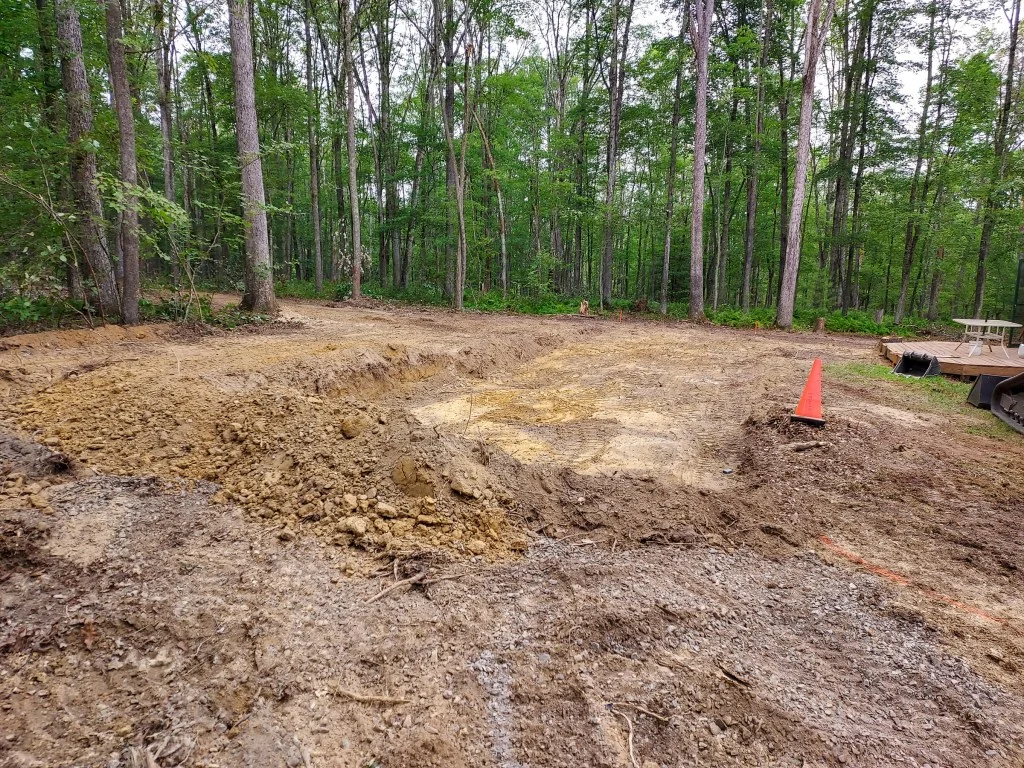
A complete culvert installation in Leicester is rarely just a pipe. A serious scope covers: pipe sizing based on the drainage area above the crossing, trench excavation to grade with a controlled slope, bedding and backfill compaction, headwall or riprap at both ends, and driveway surface repair on top. On slope lots the pipe is only half the job — inlet and outlet protection is where the money and the longevity live, and it's what gets skipped on cut-rate bids.
Corrugated high-density polyethylene is the common material; concrete is chosen where the crossing is deep or the loading is heavy. If you also need the driveway itself reshaped or a ditch graded away from the house, that work pairs naturally with the pipe — our culvert and driveway pipe guide walks through sizing, and the Buncombe County grading cost breakdown covers the dirt work around it. Bids will vary with diameter, length, and whether the ditch has to be re-cut before pipe goes in.
Leicester culvert scope-and-price ranges
Prices below are regional working ranges for Buncombe County mountain-road work, not flat quotes — a shallow replacement on a short drive and a 60-foot crossing with new headwalls are different projects. Any number given without seeing the ditch is a guess.
| Scope | Typical range |
|---|---|
| Pipe replacement, same size and length, existing trench reusable | $1,800-$3,500 |
| New 15-18 in. crossing on a residential drive, up to 30 ft | $2,800-$5,000 |
| Larger 24-36 in. crossing with riprap and headwall protection | $4,500-$7,500 |
| Long mountain-drive crossing with ditch re-cut and driveway repair | $7,500-$12,000+ |
Pipe diameter and trench length move the price fastest. Rock in the trench and the need to work around spring seep slow the job and add hours.
Water history makes this a storm-proofing job
The federal disaster record is the honest context here: 19 declared events touch this county over a span of 1973-2026, mostly storm and flood. Leicester sits on the receiving end of that in a specific way — the roads run in creek valleys, the ground is clay over rock, and undersized pipe is what fails first when a summer cell parks over the ridge. The National Weather Service records the pattern; the culvert design has to answer it. Sizing for a 25-year storm rather than a dry-week trickle is what keeps the driveway in place. Where the crossing is a roadway or an altered stream channel, the rules touch federal water programs too — see the U.S. Environmental Protection Agency at epa.gov for the general framework before assuming a ditch is just a ditch.
Permits, code, and who can legally do the work
Most private-drive culvert work in Buncombe County is straightforward, but two things trip people up. First, if the culvert is within a state road right-of-way, the work is subject to the NCDOT's requirements, not just county review, so the crossing plan has to match what the road owner will accept. Second, larger site work can cross the threshold where a licensed general contractor is required — the North Carolina Licensing Board for General Contractors at nclbgc.org sets that line, and it's worth checking before hiring. Grading and drainage that alters storm flow also needs to meet the residential code's site-drainage requirements, which the NC Office of State Fire Marshal code-enforcement office at ncosfm.gov administers. Ask any crew how they handle right-of-way and drainage review before you sign.
Choosing a Leicester crew without getting sold a pipe
The differentiating question in Leicester is sizing, not price. A crew that measures the drainage area and the existing ditch before quoting is doing the work; a crew that quotes from the driveway apron is guessing. Ask what storm the pipe is sized for, what happens to the outlet, and whether they'll handle the driveway surface afterward. Local grading contractors who work these roads already know the slopes and the county's review habits — our grading contractors in Leicester page is a starting point for crews who do this work, and it's worth asking a neighbor on the same road who they used, because ditch behavior repeats street by street.