The one-acre line that rules a Montreat clearing job
Most residential lots in Montreat are small, steep, and heavily wooded — but not all of them are under one acre, and Buncombe County's hillside parcels often are. That distinction drives the whole job. Clearing, grubbing, and grading that disturbs one acre or more of land is a point-source discharge under the federal Clean Water Act, and in North Carolina it is regulated as a construction stormwater discharge under the NCG01 general permit, administered through the NC Department of Environmental Quality (DEQ). Below that threshold, most residential clearing is handled at the local level. Above it, you need a certified erosion control plan, a financial responsibility instrument, and regular self-inspections.
That is usually what Montreat homeowners are surprised by. The trees come down in a day or two. The plan, the engineering, and the inspection cycle add weeks and real money. On a Montreat slope, the erosion risk is not abstract — one cleared acre on 20-percent grade in a heavy rain can move a season's worth of topsoil downhill into a neighbor's driveway or the creek that feeds the town's recreation area. The EPA construction stormwater program and the state's NCG01 permit exist because of that exact failure mode, which has played out in this county repeatedly.
See the broader local process overview at our land clearing guide before you call anyone.
What Montreat's terrain does to a clearing scope
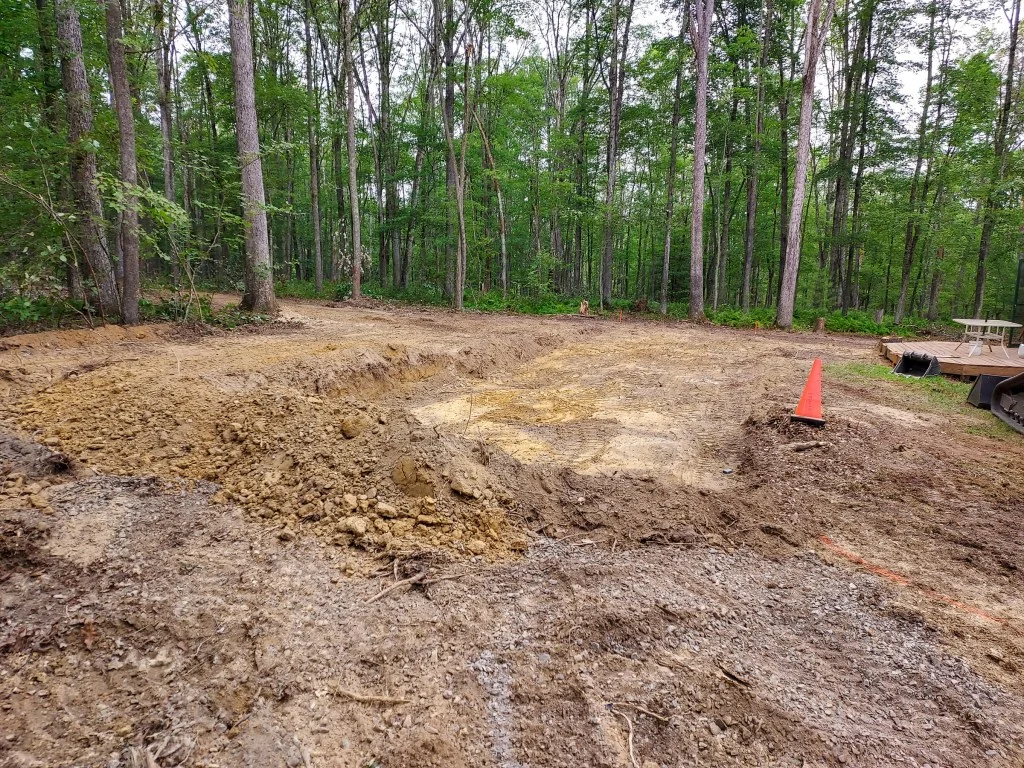
Montreat sits stacked on mountain slopes, and the town's lot pattern is unusual: many parcels carry 15 to 40 percent grades, with home sites pushed back into the hillside and driveway cuts doing the heavy lifting. A typical clearing scope here includes:
Hand-felling and winching of trees rather than clean mechanized felling, because track machines cannot access most back lots without a staging plan. Selective clearing around retained hardwoods, which usually preserves the canopy screening the town is known enough to keep. Stump grinding to grade rather than pull-out haul-off, which matters on slopes where a stump hole creates a water-collecting crater. And a drainage and erosion plan before anyone puts steel in the ground.
Slope also prices the haul-off. A residential flat-lot clearing in the low country might leave the chips and logs in place. In Montreat, most of the timber and grindings leave the site because there is no room to land them permanently. That alone is a real cost mover. For a full line-item picture, see the Buncombe County grading cost breakdown.
Storm and flood history is why the erosion plan matters
Buncombe County's federal disaster record is long and storm-dominant: 19 declared events touch this county across 1973-2026, and the majority fall in the storm, flood, and landslide family. That history is the reason local review of hillside clearing is strict. Asheville's own rainfall pattern is not gentle — the National Weather Service NWS records show this region catches some of the highest multi-day totals in the eastern U.S. Every one of those events pushed water at cleared slopes that had no cover.
For a landowner, this means the erosion control plan is not a formality. On an acre-plus Montreat job, the plan usually specifies silt fence, a sediment trap or basin, construction entrance stone, and a cover crop or matting timeline. Those line items are often a $1,200-$3,500 add-on to a comparable flatland scope, before any tree work. That is what the one-acre trigger costs, and it is why a bid that ignores the threshold should make you ask questions rather than sign.
Scope vs price: what typical Montreat clearing costs
These are regional bands, not quotes. Actual numbers depend on slope, access, timber volume, haul distance, and the permitting footprint.
| Scope | Typical Range | What drives it |
|---|---|---|
| Small lot clearing (under 1/4 acre, hand work, chips stay on site) | $1,200-$3,200 | Access, tree count, slope |
| Standard residential clearing (1/4 to 1 acre, selective, stumps ground) | $3,500-$8,000 | Number of removals, screening trees retained |
| Full lot clear for building pad (1 acre, all timber removed, haul-off) | $7,000-$14,000+ | Timber volume, haul distance, pad prep |
| State erosion permit add-on (acre-plus disturbance) | $1,200-$3,500 | Engineering, plan, inspections, cover |
| Driveway cut and grading to buildable pad | $4,000-$15,000 | Vertical feet, rock, retaining needs |
Do not compare a Montreat bid to a flat-lot bid from another county and expect the numbers to match. They will not, and the difference is mostly honest — slope access, retention of screening trees, haul-off, and the possible permit.
Licensing, permits, and what to ask before anyone cuts
North Carolina general contracting thresholds are governed by the NC Licensing Board for General Contractors — most residential clearing under the threshold is considered specialty work, but clearing that crosses into more than $40,000 of construction-grade grading usually pulls that work under a licensed GC. If a job crosses into erosion control installation on an NCG01 site, the state requires a qualified credentialed erosion control installer to oversee it, under the NC Building Code Council / NCDOI rules. Ask any contractor who bids an acre-plus job directly whether they carry that credential and whether the plan is written before mobilization or after.
Three questions that separate Montreat-capable crews from day-rate tree cutters:
- Have they worked steep-slope jobs in Buncombe County in the past two years? Slope access is its own skill set, and it is not the same skill as felling logs.
- Will the erosion plan be filed and approved before clearing begins, or started in parallel? Parallel is where fines come from.
- Who handles the haul-off and where would the material go?
Our Montreat grading contractor guide covers how to screen crews on the same criteria.