The line items that actually move a Black Mountain drainage quote
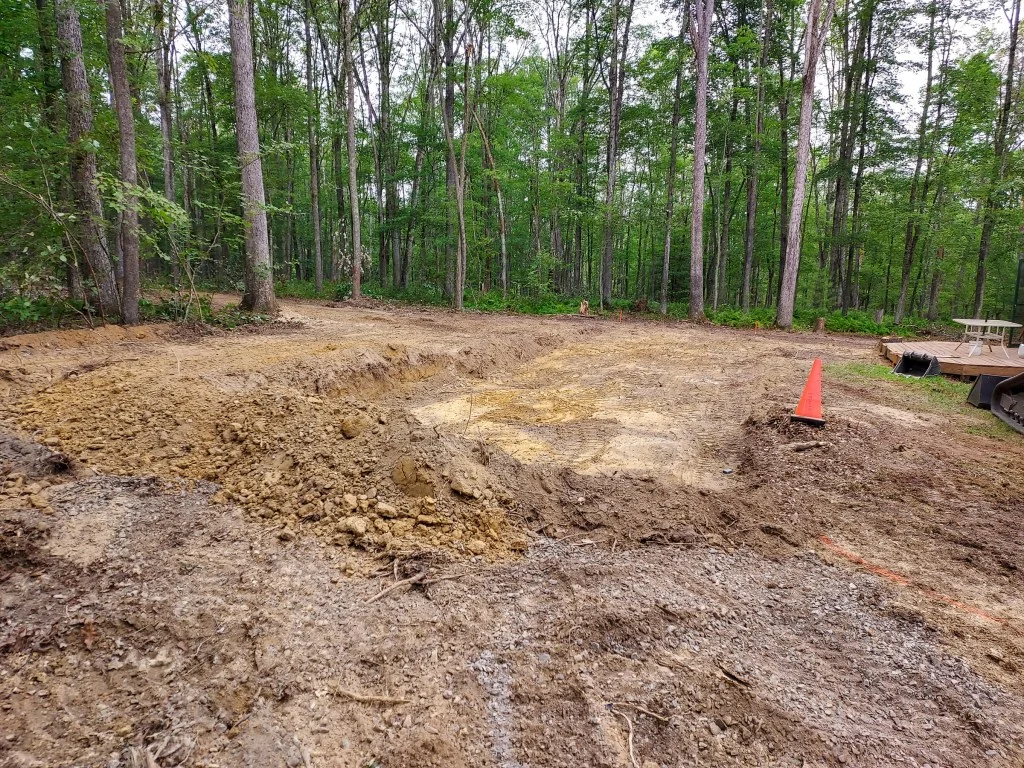
Two yards of the same size in Black Mountain can price $4,000 apart, and the square footage has almost nothing to do with it. What moves the number here, in rough order of weight: how far the water has to travel to a legal outlet, how much slope the yard already has to work with, how many downspouts and gutter runs have to be tied in, and what the crew finds once the trench is open. A lot off a ridge road where the rear yard falls hard toward a neighbor may need only a short run, and sometimes a simple surface swale, because gravity does the work. A flatter, saucer-shaped lot near the valley floor may need a long collector with a pumped or daylighted outlet, and that single decision is often the difference between the low and high end of the range.
The other honest cost driver is access. Trenches are dug with machines, and a yard the equipment cannot reach through a fence line, a retaining wall, or a steep side yard gets hand work, which shows up in labor instead of a line you can see. Any quote worth comparing names where the outlet is and how the water gets there. A number without an outlet is a number for a wetter yard.
Reading a slope lot in the Swannanoa Valley
Black Mountain sits at the mouth of the Swannanoa Valley, and most residential problems here start at the uphill property line. Water arriving from above is not yours to stop with a trench in your own yard; it has to be intercepted, redirected, and discharged where it can keep moving. The International Code Council treats surface drainage and foundation water management as a coherent system rather than an add-on, and that framing is useful here: the goal is a path for water, not a wall against it.
The tells are seasonal and specific. A basement or crawl space that smells musty every spring, mulch beds that stay saturated days after rain while the rest of the yard dries, a patch of lawn that greens up differently from the rest, and any low spot that holds water long enough for mosquitoes to breed. Fixing a single soggy corner rarely holds if the water feeding it comes from somewhere else on the property.
What different scopes cost on a typical lot
Use this as a sizing table, not a bid. Figures are for residential work in and around Black Mountain and move with outlet distance, slope, and how much soil has to be moved.
| Scope | Typical range | What sets the price |
|---|---|---|
| Single French drain run (one problem area) | $3,000–$9,000 | Run length, depth, outlet distance, stone and fabric quantities |
| Downspout and gutter tie-ins | Small add-on to the main scope | Number of runs, how far each must be carried |
| Surface swales and shallow grading | Lower end of the residential band | Linear feet, whether soil can stay on site |
| Trench drains and channel work | Mid band, rises with hardscape crossings | Driveway or patio crossings, concrete cutting |
| Whole-yard regrading and drainage plan | $15,000 and up | Volume of soil moved, removal and import, engineering |
| Combined system (collector plus regrade plus ties) | $3,500–$12,000 residential typical | Total trench and soil volume, outlet solution, access |
The Buncombe County grading cost breakdown covers the earthwork side of the same jobs, which is where combined projects usually get their biggest variance.
Storm history is the reason this work is not optional
Buncombe County's federal disaster record is 19 declared events across 1973-2026, and the dominant family is storm and flood. The National Weather Service's forecast office for this region is the authoritative source for the rainfall events that follow. That history is the practical argument for getting a drainage system right the first time: a yard that routes water poorly does not fail gradually, it fails on the heaviest night of the year, and the damage is to the foundation, not the lawn.
Erosion control matters for the same reason. Disturbed ground on a slope sends soil downhill with the first real rain, and the EPA treats sediment as a leading cause of waterway impairment for exactly that reason. A drainage build that leaves bare slope and no stabilization has not finished the job. See drainage and erosion control for how those two scopes get sequenced.
Choosing a contractor without getting sold a trench
The separating question is not price, it is the plan for the outlet. Ask any Black Mountain grading and drainage contractor to walk the property and name, out loud, where the water leaves. If the answer is vague, the quote is a guess. Ask whether the design accounts for the water coming from uphill, whether a pump is needed or gravity works, and what the ground looks like when the job is done, because a trench that stays open and bare is a future problem.
Then check licensing. North Carolina has real thresholds for when a project needs a licensed general contractor, set out by the NC Licensing Board for General Contractors, and earthwork and drainage projects do cross them. Any contractor who cannot answer plainly whether your job crosses that line is one to slow down on.